
Aesthetics is not the problem. Ownership is.
India's cities look chaotic because five departments share one road and none of them is responsible for how it looks.

By: Abhinav Bhatia
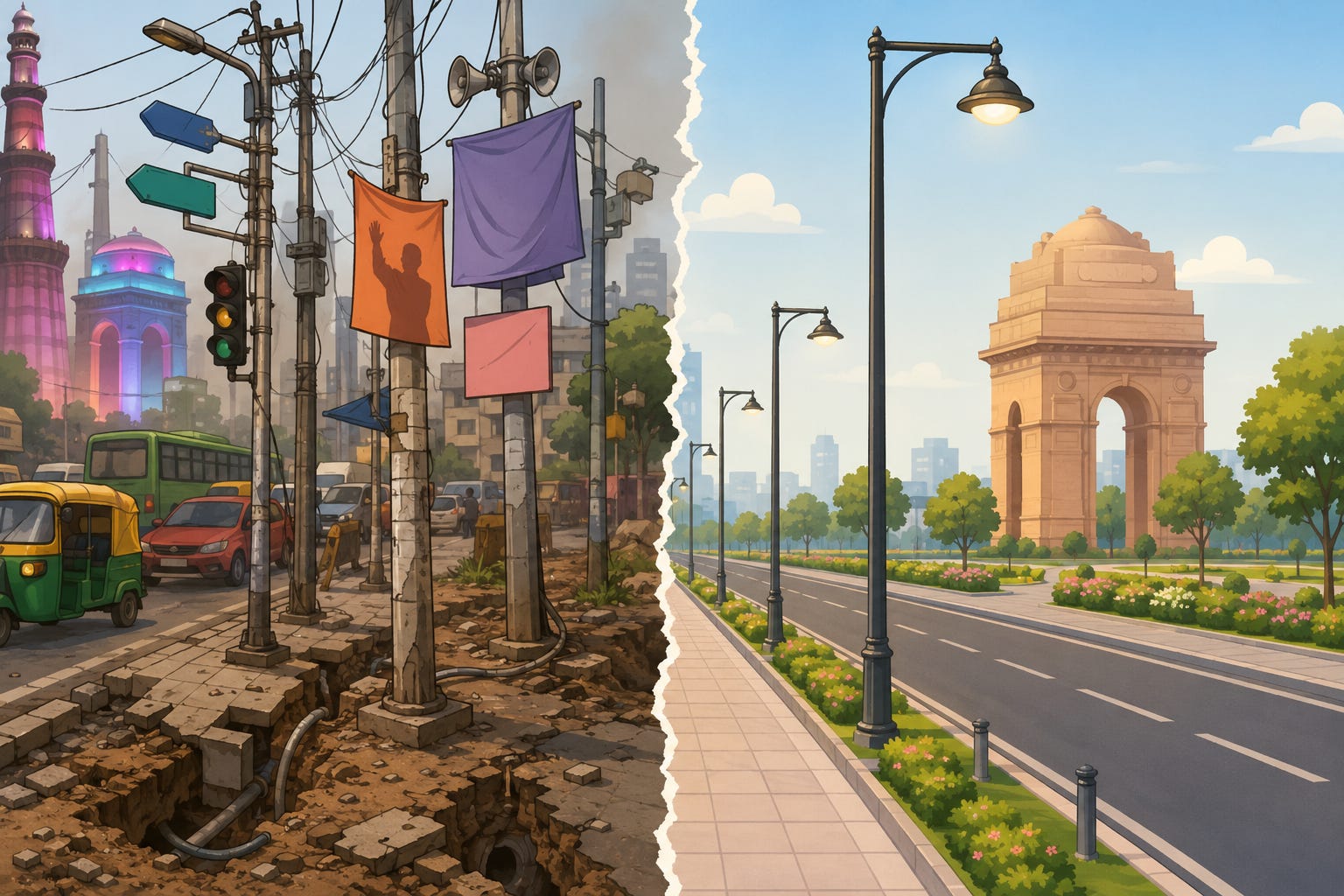
Walk through any Indian city, and you will notice something immediately: different kinds of street poles on the same road. Direction signs buried under political banners. A footpath that begins somewhere, then disappears into a construction pit, then reappears three hundred meters later. A heritage monument in what can be described as disco lighting. This is especially evident in Delhi, where monuments like Qutb Minar and India Gate are lit with random RGB lighting. This looks like chaos, because it is.
I have been following a debate that has been circulating online, which captures this frustration well. One side argues that India needs a Ministry of Aesthetics, a central body with a unified vision for how our cities look and feel. The argument makes sense. India has an extraordinary architectural heritage, a rich visual culture, and cities full of potential. And yet, monuments that would be lit with warm lighting anywhere else in the world end up looking like the backdrop of a college festival. So the frustration is real. But here is the thing: Is this actually an aesthetic problem?
I don’t think so, because the second voice in this debate makes a more stronger argument: The problem is not that India lacks taste, the problem is that no one is in charge. Jurisdictional fragmentation means that most cross-cutting problems have no single agency with authority and accountability for the whole. Take one road. The Public Works Department (PWD) manages it. The Municipal Corporation manages the street lights. The traffic police manage the signals. DISCOM handles the electricity poles. The tourism department has opinions about the heritage sites. Five departments, one road, zero coordination, and most importantly, zero shared responsibility for how the whole thing looks. In cities across India, repeated instances of newly paved roads being re-excavated due to poor coordination between PWD and other departments exemplify the systemic inefficiencies of uncoordinated governance.
There is a concept in political economy that captures this precisely. We all have heard about the tragedy of the commons, but Michael Heller, in his theory of the tragedy of the anti-commons, argued that when too many people own pieces of one thing, nobody can use it, and if too many owners control a single resource, cooperation breaks down, and everybody loses (Heller, 2013). Although Heller originally developed this idea to explain fragmented property rights, but the logic applies perfectly here. India’s public streets are not owned by anybody; they are owned by everybody in pieces. Nobody owns the road as a whole. And so nobody is responsible for what it becomes.
Thus, when nobody owns the whole picture, nobody is responsible for how it looks. The RGB lights on our monuments are not a failure of imagination. They are a failure of coordination. And this is not a small administrative problem. According to NITI Aayog’s 2021 report, Reforms in urban planning capacity, 65% of India’s 7,933 urban settlements lack statutory master plans, and governance remains fragmented across multiple agencies, creating jurisdictional issues that hinder accountability. This is the structural reality behind every broken footpath, every mismatched pole, every signboard.
So what is the solution?
Here is the thing, though, this problem does not exist everywhere. Walk into any private gated colony or a shopping mall, and you will notice that the lights match, the signage is consistent, the footpaths are maintained, and nobody has dug up the floor for a water pipe without telling anyone. The difference is not resources. It is ownership. In a mall, a single entity owns the entire property and is responsible for how it looks, feels, and functions. On a public road, nobody does. And it shows.
Let’s build on this through the example of Singapore. Cities in Singapore did not get beautiful public spaces by accident. Singapore’s Urban Redevelopment Authority (URA) is the city’s sole land-use planning and conservation agency, responsible for everything from long-term strategic plans to urban design, the conservation of heritage sites, and the promotion of architectural excellence (National Library Board Singapore, n.d.). URA is a statutory board under the Ministry of National Development of the Singapore Government. Thus, Singapore didn’t get well-maintained streets because they have better taste or aesthetics. They got them because someone was in charge of the whole picture.
Thus, what I think is the solution is not a Ministry of Aesthetics sitting at the top and issuing colour codes for lampposts. That would be a top-down aesthetic vision layered over a broken coordination structure, and it would produce exactly the kind of results you would expect: a few showcase monuments with approved lighting and everything else exactly as it was. What India might actually need is what Delhi is trying to do with DUMTA (Delhi Unified Metropolitan Transport Authority): bringing transport agencies such as the Delhi Transport Corporation, the Public Works Department, the Transport Department, and the Delhi Traffic Police under a single umbrella (Swarajya, 2025).
This approach may be replicated for the issue at hand, where a ministry that decides what things should look like is absent, but a collective body ensures the right people are in the same room when decisions are made. Urban planning and architecture are not decorative professions. They are proper professions which should be included in these conversations. Thoughtfully designed public spaces have the power to reawaken history, celebrate culture, and create meaningful connections between people and place, but that requires moving beyond the aesthetics argument and understanding the deeper problem. India’s cities do not look chaotic because we have bad taste. They look chaotic because we have built a system in which everyone is responsible for a piece, and nobody is responsible for the whole. Fix that, and the aesthetics will follow. Until then, no ministry, however well-intentioned, is going to change what you see when you walk down the street.
About the Author:
Abhinav holds a BA in Political Science and an MA in Development Studies, and brings experience in research, policy communication, and stakeholder engagement. His interests span sustainability, social entrepreneurship, and social sciences. He currently works at CCS as an Associate in the Academy.