

By : Aman Archika and Kritika Sharma
If you’re anything like us, you’ve probably mastered making your way through the lines of e-rickshaws outside Delhi Metro stations. They are such an everyday part of our commute that we rarely notice them unless it is to complain about the traffic they create. But a few weeks ago, we happened to pay closer attention. With dozens of drivers offering the same service, you’d expect fierce competition for every passenger. But that’s not always what we found.
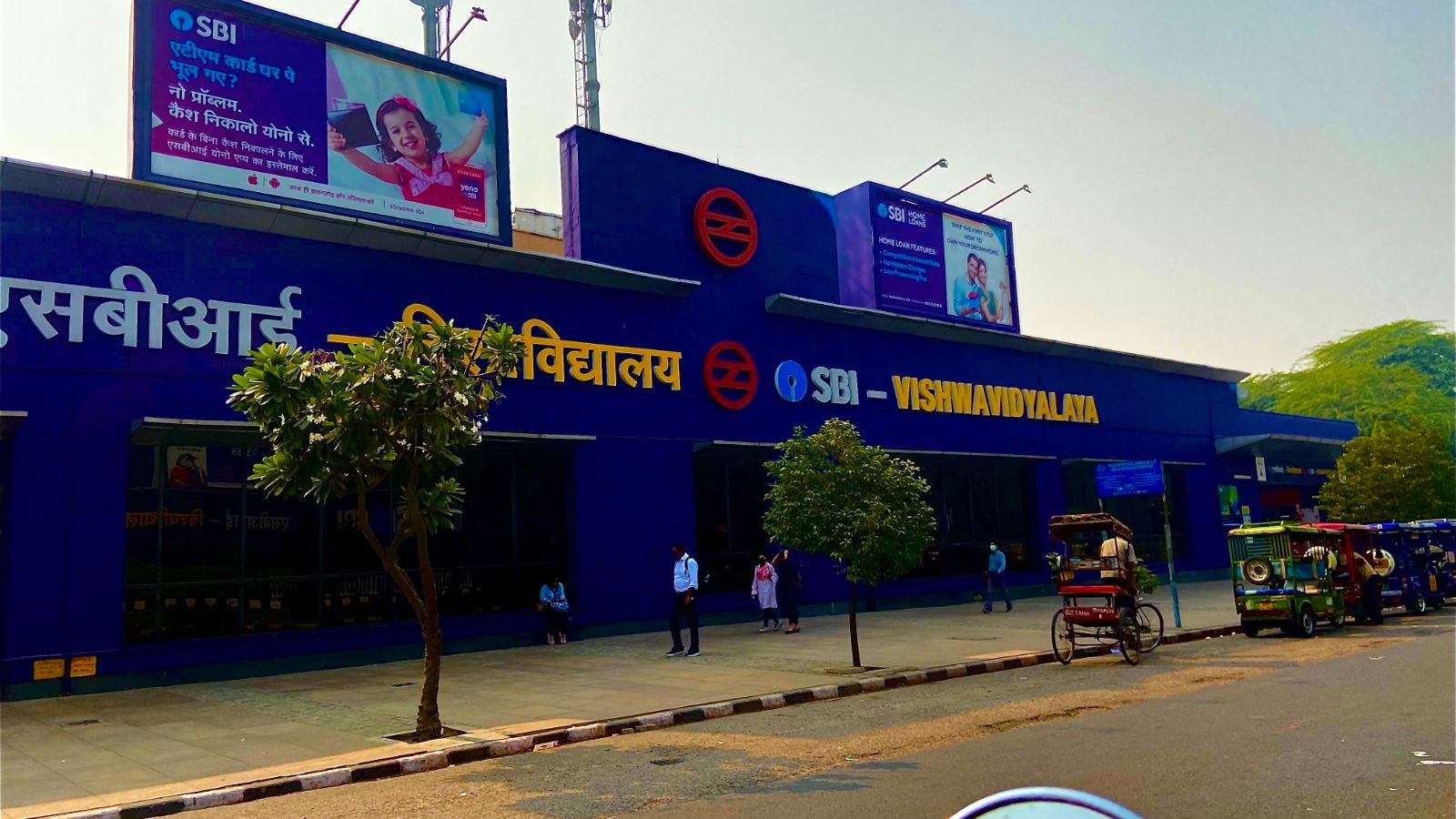
In Mayur Vihar Phase 1, drivers have developed an informal system for themselves. Each driver sticks to a particular route, and they rarely compete with each other for passengers. In fact, during our visits, we often saw other drivers directing passengers to a particular e-rickshaw driver rather than keeping the fare for themselves. On the other hand, at Vishwavidyalaya Metro Station, several drivers compete for the same passengers, and no such system is in place.
At first glance, classical market theory offers a straightforward answer for what we see at Vishwavidyalaya. The theory states that rational, self-interested actors, left to compete freely with no external referee, will default to rivalry. But the simplest version of this theory does not hold in Mayur Vihar. The drivers there sell the same service, work in the same city, and share the same goal of maximising profit, yet they behave differently from their counterparts a few stations away. Game theory offers a better account. Drawing on the Prisoner’s Dilemma, the Nash equilibrium, and Robert Axelrod’s work on the evolution of cooperation, this shows that self-interest does not produce a single fixed behaviour. It produces different stable outcomes depending on the structure of the game: who is involved, what choices they face, and whether they expect to meet again.
At Mayur Vihar, the driver community is small, and the same faces return daily. That repetition changes the incentives drivers face. In a one-off encounter, a driver gains by poaching a rival’s passenger, because there is no tomorrow to answer for. When the same drivers meet every day, poaching invites retaliation, and breaking the arrangement leaves a driver worse off than if they keep it. Given what every other driver is doing, no single driver benefits from breaking ranks alone. Game theorists call this a Nash equilibrium: a state in which every player has settled on the best response to everyone else’s behaviour, so no one has reason to move first.
Axelrod tested this logic directly. He ran a computer tournament in which different strategies played a repeated “cooperate or betray” game against each other, rather than only once. The winning strategy was strikingly simple and was nicknamed tit-for-tat. It cooperates on the first move, then copies whatever the opponent did last. Cooperation is met with cooperation, betrayal with a single retaliation rather than a permanent grudge. Over many rounds, this simple approach beat every strategy built on aggression or exploitation. Applied to Mayur Vihar, the lesson holds. When the same drivers expect to face each other again and again, cooperation becomes the smarter bet rather than a nicety.
Rigid tit-for-tat, however, has a weakness: it cannot distinguish an honest mistake from a real betrayal. It simply copies whatever happened last. Real interactions are noisy. A driver might cross into another’s route by accident, or a passenger might approach the wrong rickshaw. Strict tit-for-tat treats that misread exactly like deliberate betrayal, so the wronged driver retaliates. The other driver, who did nothing wrong, reads the retaliation as an unprovoked attack and hits back. A single misunderstanding can spiral into open conflict even though neither driver intended to break the truce. What holds Mayur Vihar together appears to be a more forgiving variant of the same strategy. Drivers appear to tolerate occasional, ambiguous lapses rather than answering them immediately, and that margin of forgiveness may be what keeps the arrangement stable when mistakes inevitably occur.
Vishwavidyalaya runs on the opposite conditions. Its driver pool is larger and more transient, and the rush-hour crowd draws in passengers few drivers will see again. Under these conditions, the one-shot Prisoner’s Dilemma takes hold. A driver who competes hard for every fare pays no future cost for it, because there is no relationship left to damage. Competing becomes the rational move each time, even though the result, mutual defection, leaves every driver worse off than cooperation would.
Different kinds of drivers do not populate Mayur Vihar and Vishwavidyalaya. The same self-interest operates at both stations. What differs is the strategic environment each station creates. Repeated interaction and tolerance for occasional error make cooperation the stable outcome at Mayur Vihar. Neither condition holds as strongly at Vishwavidyalaya, and competition fills the gap instead.
None of this overturns the classical view of competition. Self-interest explains the drivers’ behaviour at both stations. The error lies in a common shorthand drawn from that theory, the assumption that self-interested actors default to rivalry as though no other rational response existed. Self-interest instead produces different equilibria depending on whether a game repeats or ends after one round, and on whether the system can tolerate noise and error. Cooperation is not the opposite of self-interest, a moment where drivers set aside their own gain for the collective good. It is exactly as rational as competition, reached by the same logic under different conditions.
Axelrod captured the mechanism at work: in the short run, the environment determines how players behave, but over the long run, players determine the environment. Neither Mayur Vihar’s drivers nor Vishwavidyalaya’s created the conditions they operate under. Repeated interaction was already there to be exploited at one station and largely absent at the other. But once those conditions existed, drivers built the norms that fit them, cooperative at one stop, competitive at the other.
Delhi’s gig economy runs on hundreds of similar informal arrangements, and none of them needs a manager to produce order. Where drivers form small, stable groups, see each other daily, and tolerate the occasional honest mistake, they can build cooperative norms on their own. Policymakers looking to improve conditions for gig and informal transport workers should ask not how to police competition among them, but how to engineer the repeated contact and tolerance for error that make cooperation the rational choice drivers reach for themselves.
About the Authors:
Aman is a postgraduate Economics student at Guru Gobind Singh Indraprastha University, Delhi, with experience in public policy, social development, and sustainability. She has worked with the Ministry of Culture, Teach For India, and the DEFT Foundation, and is interested in education, social welfare, and evidence-based policymaking.
Kritika is an Economics student at Indraprastha College for Women, University of Delhi. Her interests include public finance, development policy, and political economy, with research on gender, fiscal policy, and welfare. She has worked with the Centre for Policy Research and Governance and Citizens for Reform India, and serves as General Secretary of her college's Economics Society.
Interesting perspective on how cooperation among Delhi’s e-rickshaw drivers can challenge the idea that competition always drives better outcomes.
Great job kritika ✨️