
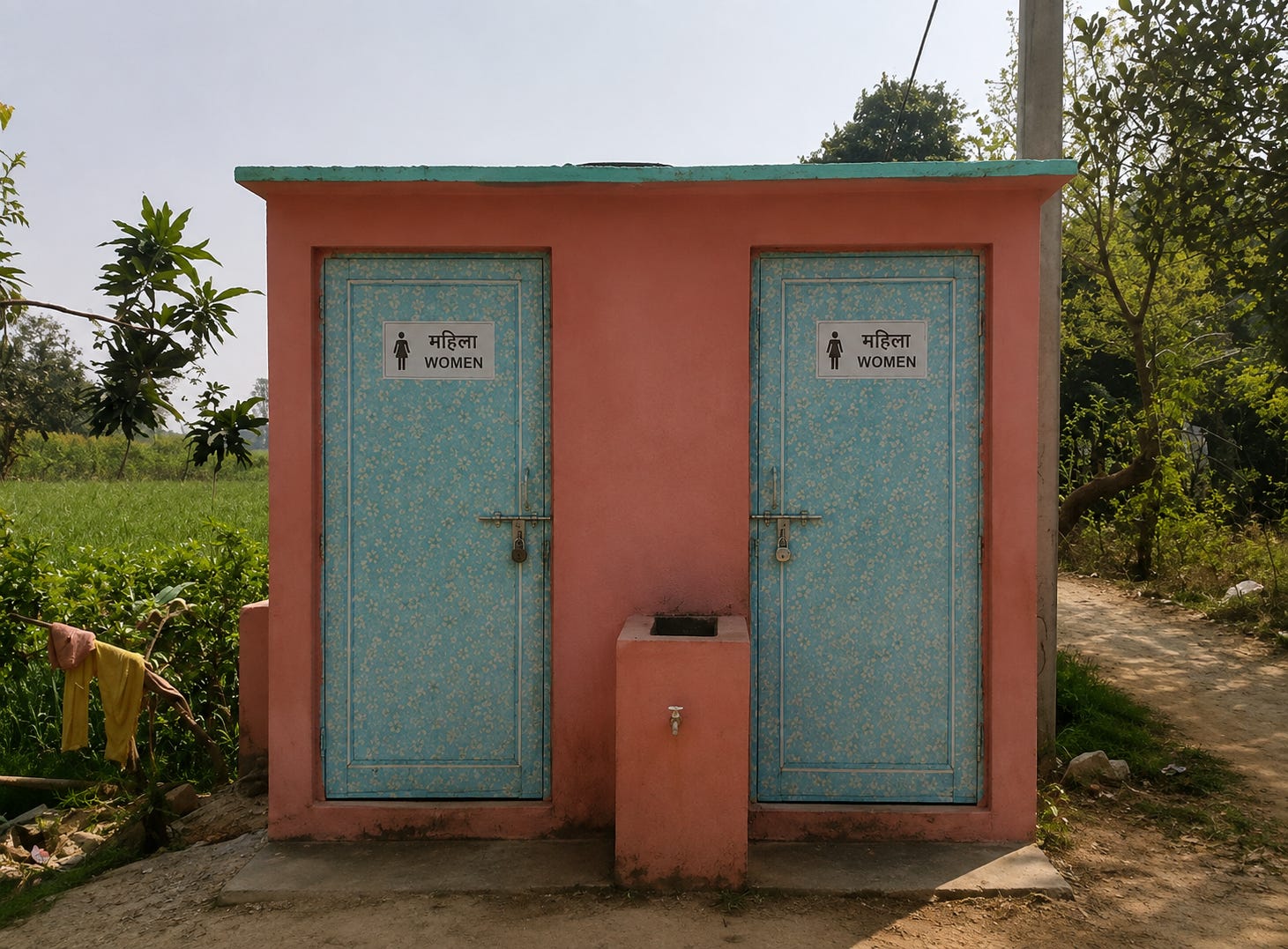
An everyday conversation with my girlfriends revealed how all of us employ various strategies to “hold it in” (avoiding urination) in the absence of safe sanitation. This “girl math” includes deliberately not hydrating enough and using the washroom several times before leaving home or the office. It also means carrying the extra weight of toilet-seat sanitiser spray, tissues, wet wipes and paper soap, just in case an emergency public-washroom visit becomes unavoidable. This is just an ordinary day for millions of Indian women. And that is before we even consider the ordeal of a menstruating woman trying to find running water to change her menstrual cup. The Annual Status of Education Report (ASER) has repeatedly released data on ‘locked toilets’ in schools across the nation, indicating that women train for this ‘toilet avoidance’ behaviour pattern since childhood, compromising on their health and dignity.
These everyday compromises are not just individual inconveniences. They are evidence of how easily women’s realities can disappear when they are not adequately captured in the data that informs policy. Data is often described as the backbone of all decision-making. The government uses it to decide its spending priorities - where to build roads, hospitals, schools and transport networks. Business owners use it to analyse market trends. Researchers use it to understand the gaps. But data will only work when it reflects the realities of everyone it is expected to represent. More often than not, Indian women disappear in the averages.
In her book, “Invisible Women”, Caroline Criado Perez argues that societies repeatedly treat men’s experiences as the “default” while women’s experiences become invisible because either they are not collected or not analysed distinctively. This gender data gap shapes and affects everything from car mortality tests to the importance of footpaths in urban planning. India is no exception.
Take urban mobility. Every day, millions of women travel across cities, but they travel differently from men. An Indian man may commute between home and work. An Indian woman, however, may drop a child at school, visit the boutique, buy medicines at the pharmacy for an elderly parent, travel to work, and stop at a sabzi-mandi before returning home, truly displaying the phenomenon of “trip chaining.” If transport surveys measure only the conventional home-to-work commute, they fail to capture these women’s actual travel patterns. When these patterns are not captured, transport planning can overlook the everyday barriers women face. Vendors and parked vehicles often make footpaths inaccessible, while poorly lit bus stops and inadequate last-mile connectivity force women to make multiple trips, adding to the burden both physically and financially. Additionally, public transport becomes inaccessible after dark because safety concerns again force women to shorten or alter their journeys. These are not merely infrastructure problems. They are evidence problems.
And this is why counting girls is not enough, but understanding their experiences is equally important. The idea is not just to separately collate statistics for men and women, but to recognise that formulating better policies requires different and nuanced data collection. Without this distinction, policies and schemes risk serving an imagined average citizen rather than real people with different needs.
What counting women would actually look like
None of this needs new technology; it just needs better questions to be asked consistently. A city budgeting for public toilets should report usable toilets per thousand women, not per thousand people, because the average hides the real gap. Education departments should track whether school toilets have doors, water, and safe disposal, not just whether a toilet block technically exists. Labour surveys should count unpaid domestic work as economic activity, recognising the millions of women whose labour remains invisible simply because it is not captured by conventional definitions of work.
India does not lack the institutions to collect gender data. It lacks the sustained priority and funding to make that data comprehensive, regular and useful for policy. As of December 2020, only 44.3% of the gender-specific SDG indicators needed to monitor progress were available for India, leaving major blind spots regarding unpaid care work, labour market outcomes, pay gaps, and women’s access to assets.
Why this is not a side issue
A toilet is where privacy, dignity, safety, and health all meet in one small physical space. This is exactly why it is one of the clearest places where missing gender data becomes a literal locked door. If a system cannot get something this basic right, it is worth asking what else is being planned using half a picture of the population.
The fix does not start with a grand policy document. It starts with a question that should have been asked decades ago: who is this space actually built for, and did anyone ask women what they need to use it safely and with dignity? The next time you stand in a long queue outside a women’s washroom, or hear that a school toilet is locked again, remember this is not bad maintenance. It is what happens when half of India goes missing from the data that shapes its cities, schools, and budgets. Counting women properly is not a favour to them. It is the minimum requirement for a country that works for everyone in it.
About the Author:
Shalini was a scholar at the Indian School of Public Policy with expertise in stakeholder management, international affairs, and policy research. She is passionate about education policy and policy advocacy, with strong analytical and communication skills. She is currently a Project Consultant at APCO Worldwide.
Thanks, Shalini. Let me know if you’d like to be connected to the Right To Pee campaign of CORO. The challenges of toilet access is real and impacts health, etc
Interesting perspective—“Girl Math” may sound playful, but connecting everyday experiences like public toilets to public policy highlights how seemingly small issues can reveal much larger social and infrastructure gaps.