

By: Aayushi Tripathi
I was in Chandni Chowk last month shopping for my sister’s wedding. If you’ve been there before a wedding, you know the drill. We were mid-conversation about products with the shopkeeper when he glanced toward the lane and said, almost as an aside, “Inspector sahab aa gaye” (the inspector has arrived). A jeep slowed near the entrance. Nobody said anything. The shopkeeper handed some money over to the inspector, and the vehicle moved on to the next shop. The shopkeeper turned back to us and continued his sales pitch as if nothing had happened.
What struck me wasn’t that the shopkeeper paid the inspector. What surprised me was the shopkeeper’s nonchalance. He made the payment while customers were in the shop, with no attempt to hide it, and no interruption to business. He told us that this inspector covered the entire lane daily and made more in a month than most salaried people make in a year, without once actually inspecting anything.
I kept thinking about that word: Inspector. It suggests that someone is checking standards and enforcing rules. But that was not what I saw. A jeep drove through, the inspector received the payment, and work continued as usual. There was no inspection, at least none that I could see. A few weeks later, I saw something similar much closer to home. Near my hostel is a small samosa shop run by a man everyone knows as Ramesh bhai. He has been frying samosas at the same corner for over a decade. Once a month, a municipal health inspector arrives; Ramesh Bhai hands over some money, and the inspector leaves within minutes. No checklist. No visible inspection. Afterwards, Ramesh bhai simply goes back to work. When I once asked him about it, he shrugged and said, “Yahi hota hai“ (This is just how it is).
Same problem, more or less.
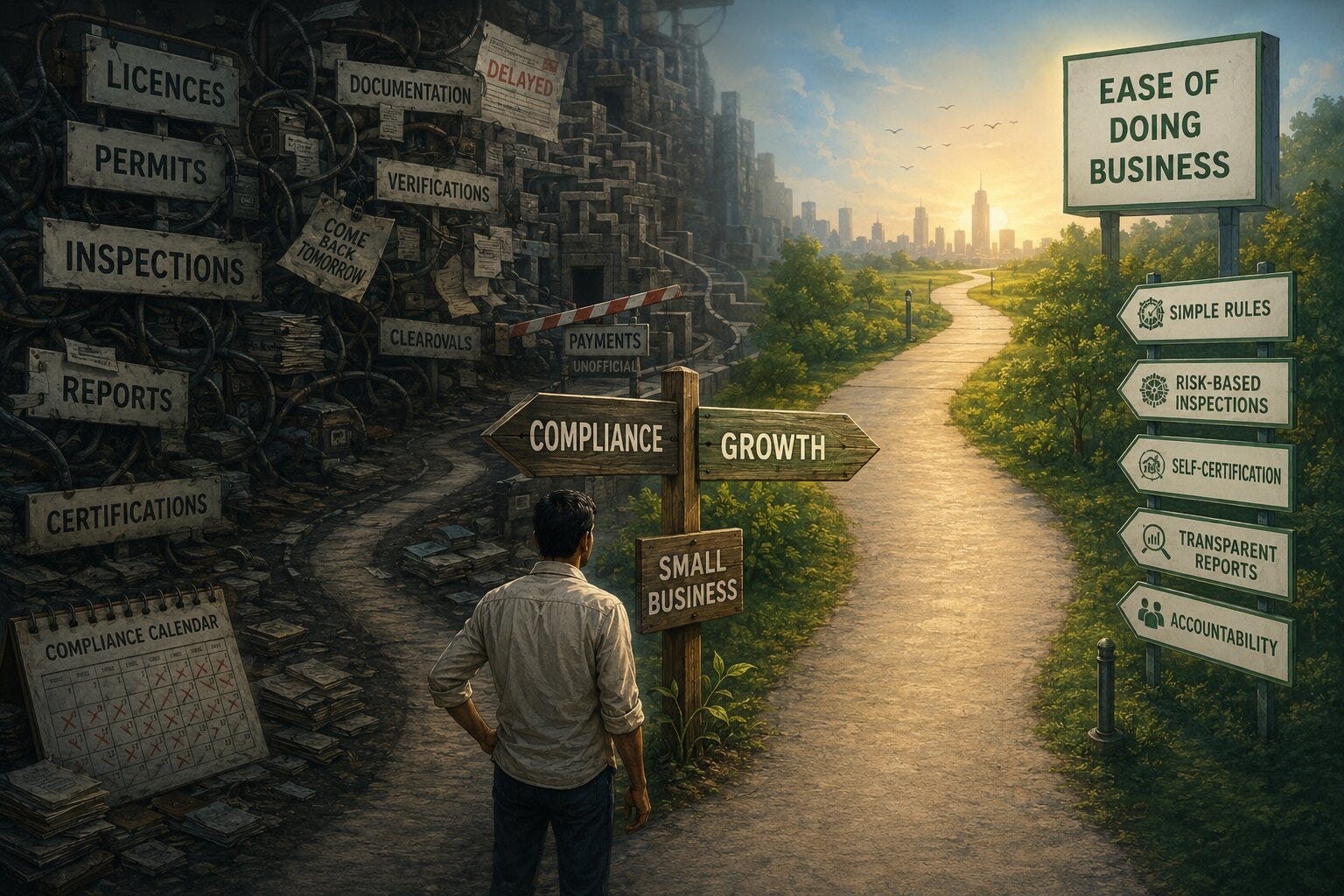
The easy response is to call this corruption and move on. Most people, including me, instinctively see these interactions as wrong. Why should this inspector take money from the poor businessman? But that’s not all that is happening. In return for the payment, the inspector ignores all the various rules that these businesses may have violated. For instance, maybe the store in Chandi Chowk doesn’t have all the licences it should. Street Vendors are not supposed to employ anyone, but Ramesh bhai does since his thela is slightly large. For these businesses, corruption is much less costly than complying with the law. In fact, if they did comply, either the prices would go through the roof, or they would shut down.
There could certainly be cases where a business is fully compliant, but still, the inspector tries to extract some money. These officials should be held accountable. But often, the time, energy, and effort required to seek formal redress are far greater than the inspector asks for.
We, as consumers, in fact, benefit from much of this corruption. Goods are cheaper and more plentiful. But the regulations and payments don’t affect every business the same way. In Chandni Chowk, such costs may be absorbed as part of doing business. For someone like Ramesh bhai, even a small additional burden can matter. The rule may be the same, but the ability to absorb its costs is not. When complying with regulations becomes costly and uncertain, the burden falls disproportionately on smaller businesses. Some absorb it. Others cannot. Over time, that affects who enters a market, who survives, and who grows.
These experiences reminded me of something C. Rajagopalachari wrote in 1963 while criticising the permit-licence-quota raj. He argued that a system created to prevent exploitation had, in practice, begun to encourage it. He wrote, “What appears as progress has been achieved in spite of the incubus, and not on account of the regimentation.” Although Rajaji was speaking about industrial licensing, the concern feels familiar even today.
A 2025 TeamLease RegTech report found that a typical manufacturing MSME faces more than 1,450 compliance obligations annually and spends an estimated Rs. 13–17 lakh a year on compliance. For a large firm, that figure is a manageable line item, spread across a much bigger operation and handled by people hired specifically for the purpose. For smaller enterprises, however, regulatory obligations are the difference between staying open and closing.
There are practical alternatives. Inspections can be targeted towards businesses that pose greater risks or have a history of violations, rather than being applied as routine monthly visits regardless of track record. The general public can access Inspection reports, allowing consumers to make informed decisions and regulators to be held accountable from outside the system, not just from within it. India has already experimented with similar approaches: several states have introduced risk-based inspection systems, and certain categories of businesses and startups can adopt self-certification.
None of these ideas is new. In 2016, RBI Governor Raghuram Rajan observed that India had largely dismantled the licence raj but had done much less to reform the inspector raj. He advocated self-certification backed by random inspections and meaningful penalties for violations. Various states have adopted versions of these reforms in some sectors, but the broader challenge remains a decade on.
The lesson from Chandni Chowk and Ramesh bhai’s samosa shop is not simply that corruption exists. Most Indians already know that. The more interesting question is why these arrangements persist even when everyone involved knows the rules are being bent and the deal is happening outside the formal system. If complying with regulations is often more difficult than finding ways around them, then reform requires more than stricter enforcement. It requires asking whether the system is making compliance easier or merely making non-compliance negotiable.
About the author:
Aayushi Tripathi is a graduate in Economics and History from the University of Delhi and is currently a Junior Associate at CCS Academy. With a strong interest in public policy, leadership, and social impact, she enjoys debating and engaging with ideas that drive meaningful change.