

By: Aishwarya Jha
If you walk down a street in urban India, you’ll likely see plastic. A blue tarpaulin sheet fluttering off a rooftop. A drain choked with plastic sachets. Somewhere, a cow nibbles on a carry bag, mistaking it for fodder. Plastic has become so central to our lives that we have normalised it, even as we drown in it.
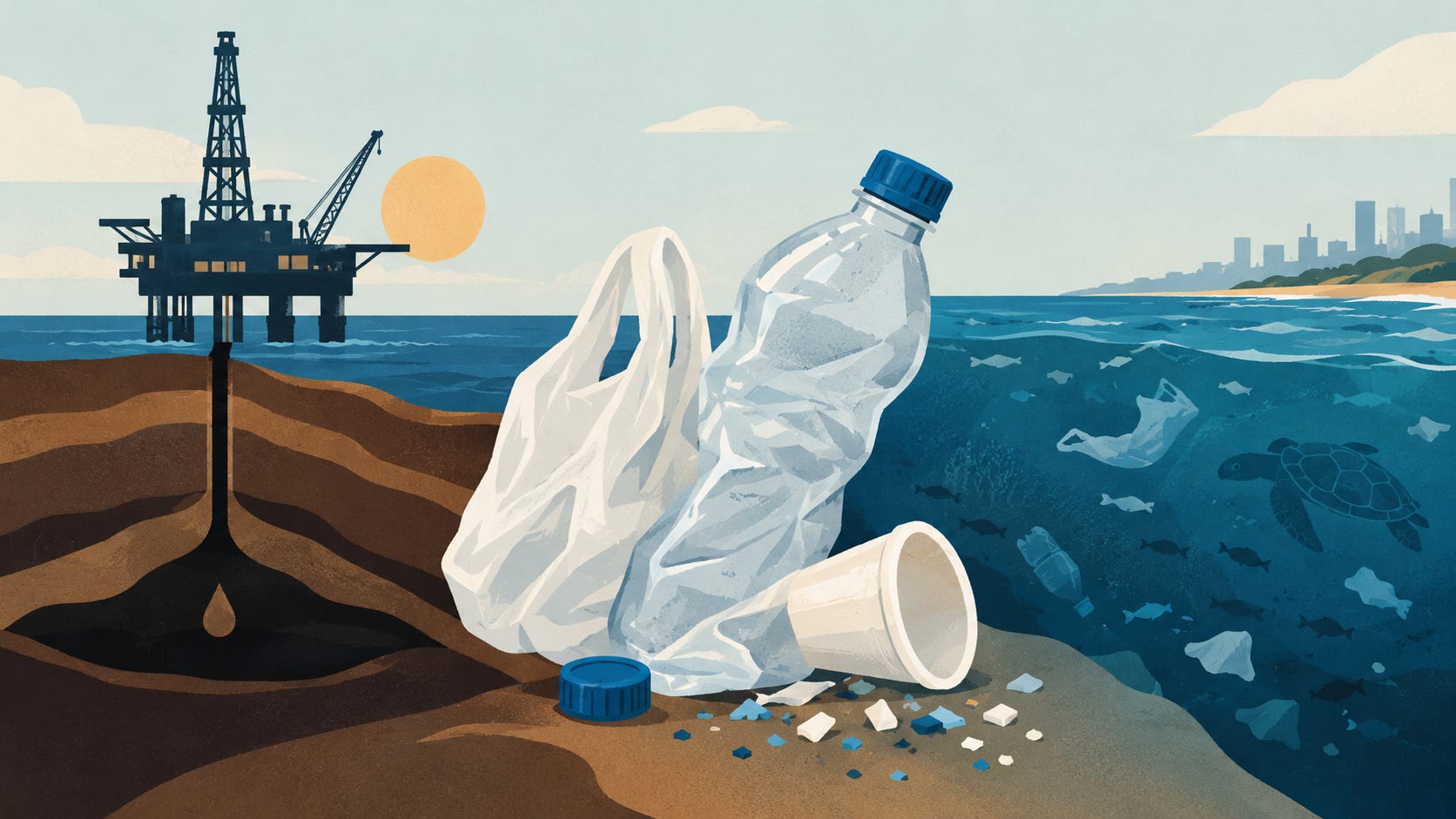
We cannot ignore that fossil fuel deposits, coal and oil, are compressed remains of ancient plant and animal life, buried over millions of years. If current consumption patterns remain unabated, plastic may well become the defining fossil of the Anthropocene. According to a 2024 study published in Nature, India generates 9.3 million tonnes of plastic waste annually.1 This figure includes both formally managed plastic waste and waste managed by the informal sector. India’s per capita plastic consumption of 15 kilograms a year remains lower than the global average.2 However, rising disposable incomes are quickly narrowing that gap as production and consumption increase.
The health crisis is no longer speculation. Microplastics have been detected in human blood, lungs, heart and brain and pose concerns for cardiovascular, neurological and endocrine health. Adding to these concerns, persistent organic pollutants such as mercury bioaccumulate up the marine food chain and ultimately end up on our plates. As per a study published in Environmental International, polymer dust has now been identified as an air pollutant, thereby widening the pathways of exposure.3 Wildlife across terrestrial, avian or aquatic ecosystems bears the same burden through bioaccumulation and biomagnification. Further, our traditional disposal methods like open-air incineration not only fail to address the problem but also generate secondary air pollutants, converting solid waste into airborne toxins.
Here is an unpleasant economic truth underpinning all of this: plastic pollution is a textbook negative externality. A manufacturer that sells a packet of chips or a shampoo sachet captures the maximum value of that sale, while the public bears the end-of-life cost through plastic-choked drains, polluted soil, contaminated water, and air. Producers individualise the profit and socialise the cost. When prices ignore externalities, markets misallocate resources, and the economy ends up overproducing cheap, disposable plastic at levels well beyond what a market that accounts for actual costs would ever choose.
India’s response, for decades now, has been to legislate its way out of the crisis. The Plastic Waste Rules of 2011 built the first holistic legal framework.4 It prohibited the manufacture, sale, and use of plastic bags less than 40 microns thick and, notably, integrated waste pickers, the kabadiwalas and ragpickers, into formal waste management chains. The 2016 Rules went a step further by introducing the collect-back system, or the lifecycle responsibility, now called the Extended Producer Responsibility (EPR) system.5 It aimed to operationalise the polluter pay principle by holding producers responsible for the plastic they introduce into the market. Subsequent amendments in 2018, 2021, 2022, 2024, and 2025 have increased plastic bag thickness, prohibited low-utility single-use plastics, categorised plastic waste by type, introduced tradable EPR certificates, and mandated a QR-code traceability system.
The latest amendment, introduced in 2026, now requires a minimum level of recycled content in plastic packaging.6 The rules mandate at least 30% recycled content in rigid plastic packaging for FY 2025-26, increasing to 40% by April 2026 and 60% by FY 2028-29. However, the amendment also permits producers who fail to achieve these targets to carry forward their deficit for up to three years, provided they make up at least one-third of the shortfall each year. Introduced after industry representations, this provision underscores a recurring feature of India’s plastic governance: ambitious targets are often paired with compliance relaxations.
On paper, this seems like a gradual regulatory progression. But in reality, plastic use and waste have continued to rise. This reflects limitations in its regulatory design. India has built a command-and-control regime that concentrates authority at the top while neglecting incentives for the actors actually involved in collection and recycling.
India’s EPR system is the most market-oriented element of its plastic waste regulatory mechanism. It was designed to work like carbon credits, where producers who exceed their obligations sell certificates to those who fail to meet them, ensuring compliance at minimal cost. Though the idea is economically sound, it has been poorly executed. A report published by the Centre for Science and Environment revealed roughly 70,000 fake EPR certificates in circulation, with several polluters simply escaping the regulatory ambit.7 Without third-party checks and balances, the EPR certificate framework has become vulnerable to manipulation. A market allocates resources efficiently only when the underlying claims are credible. Fictitious compliance certificates do not represent market failure; instead, they constitute the absence of a genuine market. Though the state enacted the regulatory framework, it failed to develop the audit infrastructure required to sustain it.
Then there is India’s taxation structure, which runs counter to circular-economy policy. Scrap materials, plastic, and metal waste are taxed at the same 18% GST as virgin raw material.8 Beyond bureaucratic inertia, there is little justification for imposing the same tax burden on recycled and newly manufactured plastic. The effect is highly predictable. Formal recyclers that comply with tax obligations are priced out by the informal sector, shifting recycling into the informal economy and increasing the ecological burden. This is not a market failure, but government failure that aggravates a solvable problem.
None of this implies that the law is irrelevant, or that the plastic waste crisis should be left entirely to the market. Instead, the state’s role should be confined to developing an enabling regulatory framework by codifying explicit rules, enforcing standards, ensuring credible verification and allowing markets to work efficiently. India’s informal waste sector already processes a significant share of the country’s plastic waste cost-effectively, yet it remains almost entirely excluded from formal policy. A liberal approach to this crisis does not mean fewer regulations, but rather better-designed ones. This includes recognising informal recyclers as legitimate economic participants in the waste ecosystem, strengthening third-party verification in the EPR framework, providing tax incentives to encourage the use of recycled materials, and removing unnecessary regulatory barriers to encourage innovation in sustainable and alternative packaging materials.
Like Delhi’s winter smog, the plastic crisis ultimately asks who bears the cost of pollution they did not create. The answer lies not in adding new layers of centralised regulation to an already complex and weakly enforced legal framework. Instead, it calls for creating a system that aligns economic incentives, establishes clear accountability and empowers the informal stakeholders who sustain India’s circular economy. India’s real test is not whether it can enact yet another amendment, but whether it can build a system honest enough that the next one isn’t needed.
About the author:
Aishwarya Jha is a Supreme Court lawyer working in litigation, legal research, and environmental issues. She is also the co-founder of Project Purple Planet (P3), focused on climate literacy and research.