

By: Aanya Monga
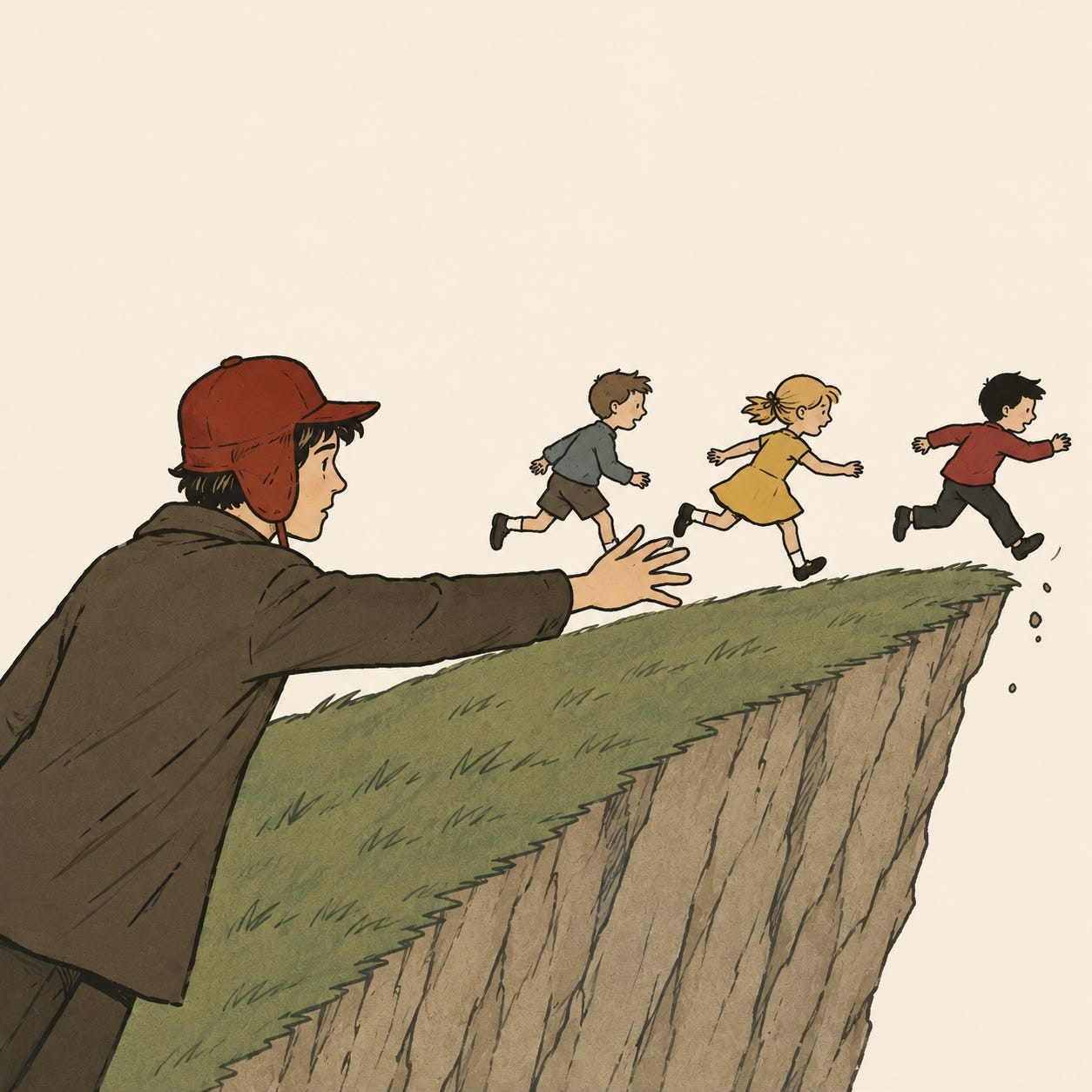
Near the end of The Catcher in the Rye, Holden finally tells his sister, Phoebe, what he actually wants to do with his life. Holden imagines a field of rye on the edge of a cliff. Thousands of children play in the field, and nobody watches them but him. His job, the only one he can picture wanting, is to stand at the edge and catch any child who strays too close to the drop. He does not want to teach the children, play with them, or ask where they are running. He wants to stand at the boundary and stop the fall.
Strip away the poetry, and Holden has designed a policy. Some people, in his account, cannot see the risks they run. One other person, wiser or more cynical, must stand at the edge and intervene on their behalf. This is paternalism in its most literal form. A milder policy leaves the choice of action to citizens themselves. Holden’s fantasy removes the choice entirely. The protector decides what counts as danger, and the children never learn he is there. Even if they did, nobody asked him to catch them.
This fantasy is well-intentioned, which is what makes it a strong policy case. Nobody builds a restriction on other people’s freedom out of contempt. They build it out of love, fear, or grief, and Holden is writing from grief. He has lost his brother Allie, watched a classmate die, and concluded that the world is a place children fall out of. His catcher fantasy turns that grief into a vocation. Real paternalist policy works the same way. It is rarely the product of malice, and that is precisely what makes it hard to argue against.
The case for the catcher collapses under three questions.
First, who decides what counts as falling? Holden assumes a clean line between the safe field and the fatal cliff edge. But the children running through the rye are not all running toward the same danger. Some are running toward growing up, which Holden experiences as a kind of death, but it is also how anyone becomes their own person. A catcher who cannot tell a child about to be hurt from a child about to change will end up stopping both. He is not qualified to judge what falling means.
Second, what does the child lose when the choice disappears? The child who is caught never learns what waited on the other side of the risk. Holden spares her the fall, but he also spares her the agency, the accountability, and the experience of judging a risk and living with the result. That experience is what turns a child into an adult who can judge the next one. And because the child never jumps, Holden never has to face the possibility that the fall was survivable, or worth it, or none of his business to prevent.
Third, did anyone ask? The children play, Holden watches, and the catching happens to them, not with them. There is no consent, because the whole premise denies them the standing to give it. Every paternalist scheme rests on this same move. To justify acting on someone’s behalf, you must first prove they cannot act for themselves, and the more thoroughly you prove it, the less they look like people whose interests you can claim to know.
Salinger frames this argument from an unusual angle. Holden narrates the whole novel from inside a psychiatric facility, where his family sent him after his breakdown. The boy who dreams of catching children has himself been caught, removed, diagnosed, contained. The adult world aims the same protective impulse at Holden that Holden aims at his imaginary children. Salinger shows both sides of paternalism at once, the good intentions behind it and the cost it rarely lets you see, a loss of self. The catcher’s reward is to be caught and catalogued by other catchers.
The strongest evidence that Salinger argues against the catcher, rather than for him, comes in the final scene. Holden takes Phoebe to the carousel. She reaches for the gold ring the way children on old carousels did, leaning off her horse far enough that she could fall. Holden watches, and he lets her. This moment reverses the whole field of rye. The loving act is not to stand between the child and the risk. It is to step back far enough that the risk becomes hers to take. Holden does not stop fearing for Phoebe. He simply accepts that his fear gives him no right to govern her choices. That distinction between caring about someone’s well-being and claiming the right to override their choices is the argument against paternalism in full.
Salinger did not set out to write a treatise on autonomy, and I doubt he’d recognise this reading. But the policy lesson holds regardless. Before we build the cliff-edge institutions, the bans and mandates and schemes that catch people for their own good, his three questions are worth asking first.
Aanya Monga is a Grade 11 student at DPS International Saket, New Delhi, with a deep passion for politics, philosophy, economics and IR. An avid reader, researcher and public speaker, she likes engaging with ideas that connect abstract thinking to real-world governance.