

By Kavya Rao
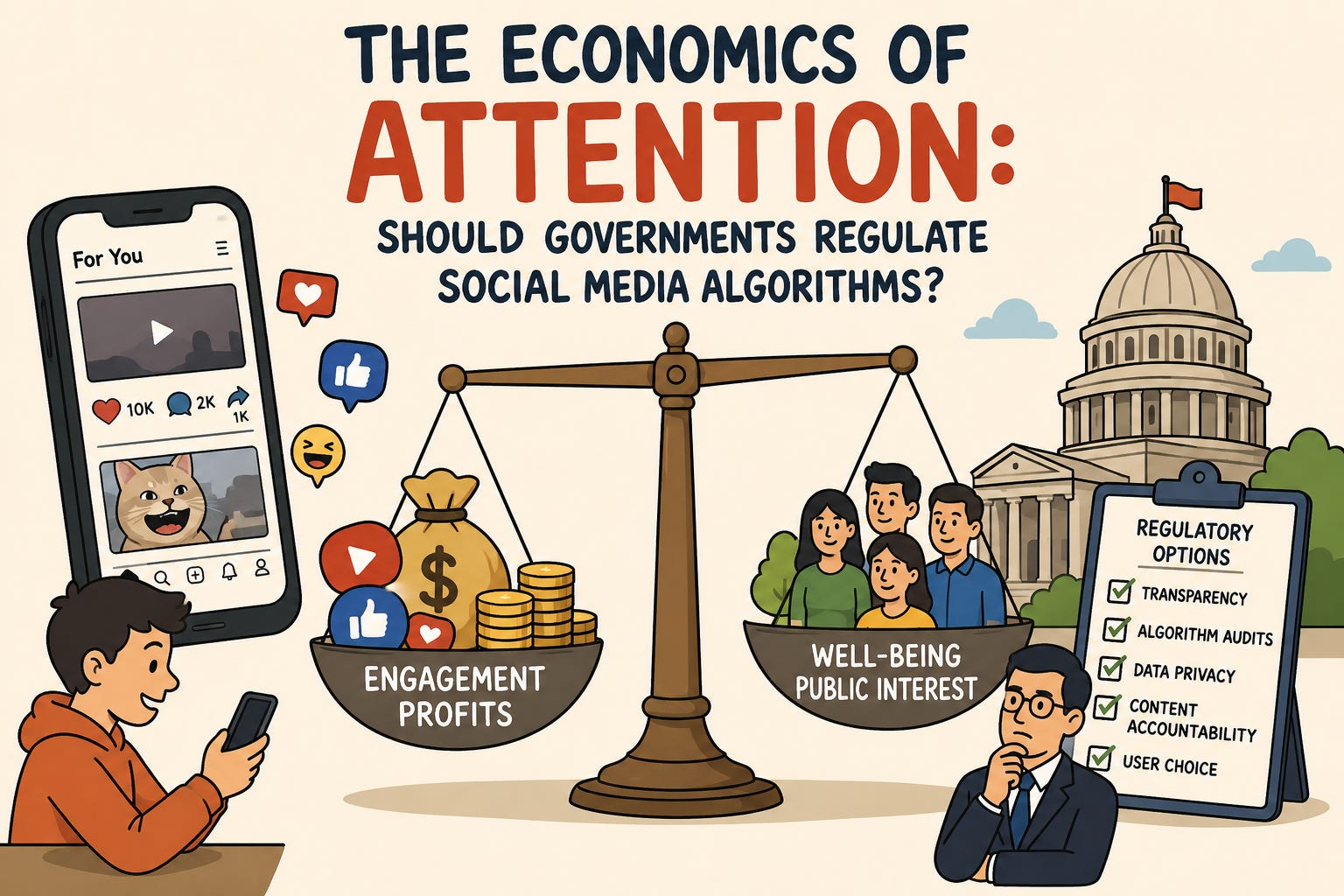
In the digital age, attention has become one of the world’s most valuable resources. Social media platforms compete not only for users but also for the time users spend on their applications. Their algorithms, which determine the content people see online, are designed to maximise engagement by keeping users scrolling and interacting. Although these platforms have transformed how people communicate and access information, they have also raised concerns about misinformation, mental health, and market power.
This raises an important question: should governments regulate social media?
From an economic perspective, attention is a scarce resource. Individuals have limited time and cognitive capacity, so every minute spent on one activity comes at the expense of another. Social media companies monetise attention by selling advertising space. The longer users remain on a platform, the more advertisements they see, generating greater revenue. Firms therefore have strong incentives to design algorithms that maximise engagement, often by promoting emotionally charged content because high-arousal emotions encourage users to continue scrolling.
However, the market for attention can produce several forms of market failure. One is negative externalities. Algorithms may amplify misleading or inflammatory content because it generates engagement, while the resulting social costs are borne by the public rather than the platform. In India, platforms also benefit from safe harbour protections under Section 79 of the Information Technology Act, which generally shields them from liability for content posted by third parties.
The consequences of misinformation extend well beyond individual users. It can undermine public trust in the media and public institutions, distort political outcomes through voter manipulation and coordinated disinformation campaigns, and increase social polarisation. False narratives and hate speech can encourage people to view political opponents not simply as individuals with different opinions but as existential threats.
Another economic concern is information asymmetry. Most users do not understand how algorithms select and rank content. Platforms possess extensive data about user behaviour and detailed knowledge of how their recommendation systems operate, while users know very little about how their attention is being influenced. This imbalance limits consumers’ ability to make informed choices and weakens market discipline. Unlike traditional markets, where consumers can compare products and prices, the mechanisms behind algorithmic recommendations are largely opaque. Modern AI systems rely on complex statistical models trained on vast datasets rather than simple human-written rules, making it difficult for users, researchers, and even regulators to understand why particular content is promoted.
Governments have responded to these concerns in several ways. Measures such as stronger content moderation requirements, transparency obligations, age-appropriate design codes, and regulations like the European Union’s Digital Services Act aim to increase platform accountability and reduce the spread of harmful content. Many companies have also invested in AI-powered moderation systems to detect misinformation, hate speech, and other harmful material more effectively.
Despite these efforts, significant challenges remain. Regulators still lack a universally accepted definition of misinformation, making enforcement difficult without risking restrictions on freedom of expression. Automated moderation systems often struggle to identify misleading content that mixes factual information with false narratives, particularly in regional and low-resource languages. Safe harbour protections may also shield platforms even when their algorithms actively amplify harmful content. At the same time, recommendation systems evolve rapidly, causing legislation to become outdated before it can be effectively implemented. Increased moderation requirements can also lead to overblocking, in which legitimate journalism, political criticism, and artistic expression are mistakenly removed. Similarly, age verification measures designed to protect minors often require the collection of sensitive personal information, raising important privacy concerns. These limitations suggest that existing regulatory frameworks remain insufficient to address the complexities of the modern social media ecosystem.
Policymakers must also consider the unintended consequences of excessive regulation. Strict rules may discourage innovation and make it harder for smaller firms to compete with established platforms that possess greater legal and financial resources. There are also concerns about freedom of expression. Deciding which content to promote or restrict is inherently difficult, and greater government involvement in algorithmic decision-making may pose risks of censorship or political interference.
A balanced regulatory approach is therefore likely to be the most effective solution. Rather than regulating individual speech, governments should focus on platform behaviour by promoting transparency and accountability. Platforms could be required to disclose how their recommendation systems operate, the factors influencing content visibility, and the processes used to moderate content. Greater transparency would reduce information asymmetry by allowing users, researchers, and regulators to better understand how information is prioritised online.
Governments should also distinguish between hosting content and actively amplifying it. Platforms should not be held responsible for every post made by users, but they should be accountable when their algorithms systematically promote harmful or misleading content to maximise engagement. Independent audits and regular risk assessments could improve accountability without giving governments direct control over online discourse.
Digital literacy programmes should also complement regulation. Educating users about misinformation, algorithmic bias, and online manipulation would reduce their vulnerability to harmful content while preserving freedom of choice.
Ultimately, social media algorithms provide significant benefits by expanding access to information and enabling global communication, but they also generate social and economic costs. Government intervention is therefore justified, provided it focuses on transparency, accountability, and user empowerment rather than extensive control over online content. Such an approach is more likely to protect both public welfare and freedom of expression.
In conclusion, government regulation of social media is justified because the market for attention generates important market failures, particularly negative externalities and information asymmetry. Left entirely unregulated, platforms have strong incentives to prioritise engagement and profit over social welfare. At the same time, excessive regulation risks reducing innovation and restricting freedom of expression. A balanced approach is therefore essential. By improving algorithmic transparency, holding platforms accountable for harmful amplification, and investing in digital literacy, governments can correct market failures while preserving the fundamental freedoms that make open societies possible.
Kavya Rao is a Grade 11 student at The Shri Ram School,Moulsari, with a strong interest in business and economics. She enjoys tackling challenging projects that require research, critical thinking, and problem-solving.
This raises an important question: should governments regulate social media?goverment should take proprer action on this fild