

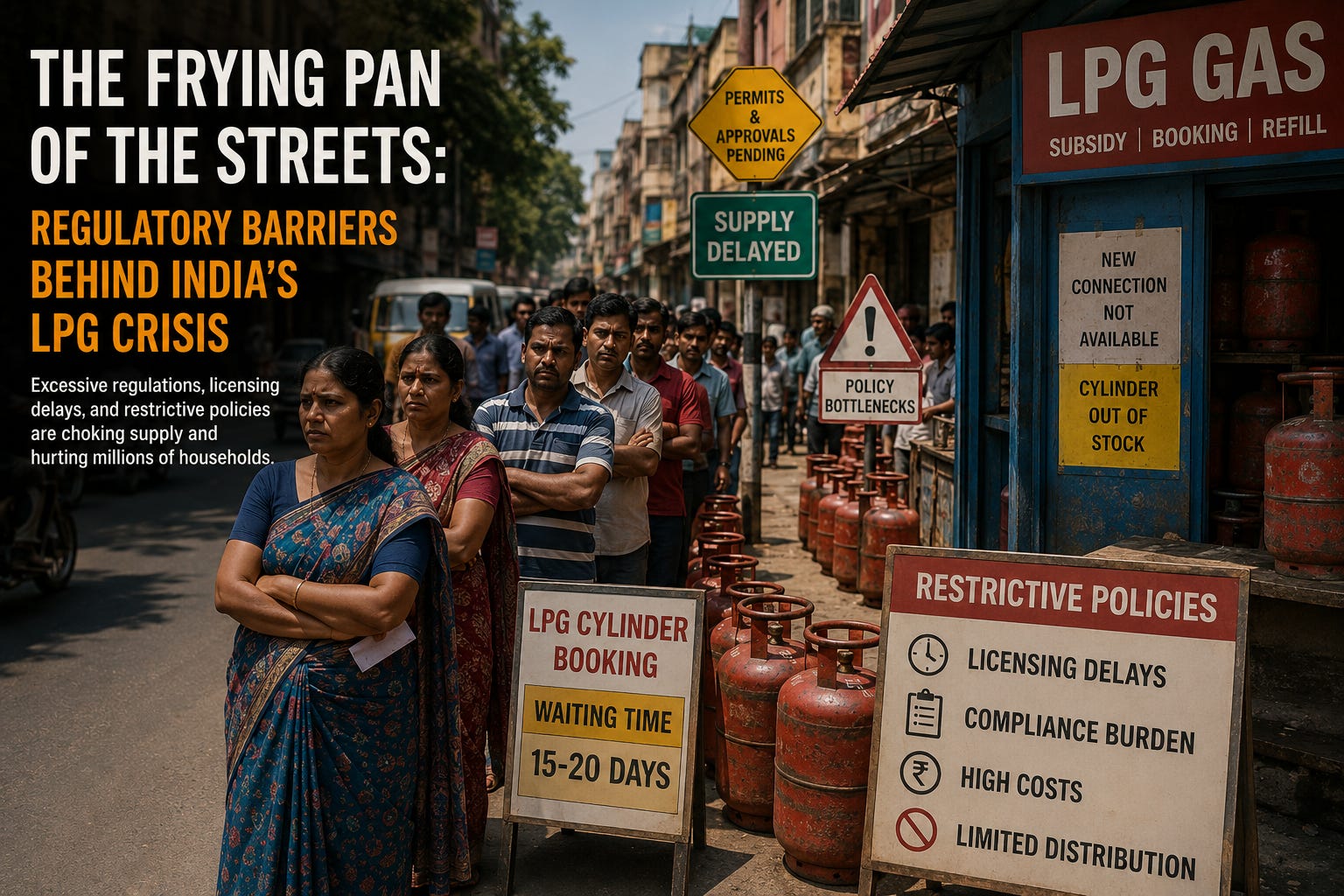
Every evening across India, thousands of street vendors light their stoves, and the hiss of blue flame marks the start of the working night. For these micro-entrepreneurs, liquefied petroleum gas is not a convenience but the fuel that powers their livelihoods. It is the difference between earning that day and not earning it.
That fuel has become a source of constant worry. A field survey of more than 90 street vendors in Delhi and Jaipur, conducted in April 2026, points not to a passing inconvenience but to a system failing the people who depend on it most. Regulatory barriers have shut the poor out of the legal market, over-regulated their work, and left them exposed to every price shock that comes.
The Scale of the Disruption
The disruption is widespread. Of the 78 LPG-dependent vendors surveyed, over 90% reported severe daily operational disruptions in the past 30 days. This situation is not a minor financial setback but a structural failure. Vendors face chronic refilling delays, forced shutdowns of up to 12 days, and a 250% premium charged by the black market.
Take Rajesh, a tea seller at Old Delhi Railway Station. When the shortage first hit, he spent his small savings stocking up on cylinders, expecting it to pass. It did not. Prices climbed week after week and ate through his capital.
At the same spot, Shivpal, who sells cooked meals to daily-wage labourers, was paying Rs 3,500 for a single domestic cylinder, nearly four times the regulated price of Rs 950. That gap is days of hard physical labour swallowed at once, just to buy the fuel to cook for one more day.
A Tripled Price on a Thin Margin
The same pattern shows up across both cities. In Lalarpura, Jaipur, a fast-food vendor named Tejpal watched his fuel costs rise over 30 days leading into March 2026, from the regulated rate of Rs 950 to between Rs 2,800 and Rs 3,200 per cylinder on the black market. That is roughly a threefold increase in a matter of weeks, leaving micro-entrepreneurs little time to adjust and turning a stable input into a threat to the business. For a stall that gets through three or four cylinders a month, that adds Rs 5,000 to Rs 9,000 to its costs.
And vendors cannot pass on the extra cost. Their customers watch every rupee and will simply go elsewhere, so the vendor absorbs the rise himself. Manoj, who sells aloo chaat in Chawri Bazar, put it plainly: “Crisis is temporary, but customers are permanent.” He takes the loss and watches his daily profit shrink to almost nothing.
Unlike air-conditioned corporate restaurants, street vendors have no fiscal cushion. As Shivpal puts it, they operate at the margins of survival, where losing a customer can mean losing the means to feed their own families that night.
Slowing the Pace of the Streets
In Chawri Bazar, a tea seller named Hasan normally works a nine-hour shift, opening his stall at 2:00 PM and serving customers until 11:00 PM. Because of the fuel shortage leading into April 2026, he has been closing two hours early, at 9:00 PM, simply because he cannot secure a reliable supply of LPG. That loss of his late-night hours strips away more than 20% of his daily operating window and cuts directly into his main source of income.
In Mukherjee Nagar, the price swings made it hard for vendors to know what their fuel was really worth. One vendor, Upendra, was out of work for several days. The pause was deliberate: with black-market prices moving hour by hour, he chose to wait and see whether the 250% spike would hold or fade before committing. A vendor with no financial cushion cannot afford to misjudge, since paying an inflated rate for fuel or setting his menu around it could exhaust the working capital he has left.
The financial strain is not the whole story. Locked out of legal commercial LPG, some vendors have gone back to firewood. Between 15% and 18% of those surveyed said they had given up gas stoves in favour of solid biomass, and in Lalarpura, Jaipur, seven vendors, including Raju Gurjar, switched to firewood as a stopgap.
The switch costs more than it first appears. Firewood runs Rs 13 to Rs 20 a kilogram, and on top of that, vendors lose hours scouting local markets to find it, time they would otherwise spend serving customers. It also cooks more slowly. As Deepak, a vendor in the same area, puts it: “An LPG stove is faster and easier to operate. A wooden stove takes far longer to heat up. I cannot make tea on demand, and serving fewer customers means lower daily income.”
Rules that keep affordable LPG out of vendors’ hands push them toward a slower, costlier fuel, which means fewer cups of tea sold and less money at the end of the day.
Caught in the Trap
The core policy problem is a design flaw in the market’s structure: the state over-regulates the vendor’s physical space while denying him any formal commercial identity. To buy a legal 19kg commercial cylinder from the state oil companies, a business must produce a municipal trade licence, proof of permanent address, or formal commercial registration. But municipal corporations have frozen zoning laws and stalled on issuing Certificates of Vending under the Street Vendors Act, so the great majority of vendors hold none of these documents.
The result is a system in which a roadside tea stall sits in the same commercial tier as a five-star hotel, yet is denied the paperwork it needs to legally buy that fuel.
With no legal route, vendors break the rules to survive. Shamim, a tea seller in Hasanpura, says he uses domestic cylinders simply to stay in business, working each day in fear of a fine.
That fear is well-founded. Also in Hasanpura, Usman and Kishan Singh had their cylinders seized during police raids, losing the one tool their livelihood depends on.
The trap closes from three sides. The system bars vendors from the legal supply chain, pushes them into a black market where the likes of Mangi Lal and Sonu Srivastav make call after call to find a cylinder at Rs 2,800, and then sends the police to punish them for buying it. The system is an institutional failure of a basic kind. The system does not protect the vulnerable. It punishes them for surviving.
A Blueprint for Reform
The accounts of Rajesh, Shivpal, Tejpal, and Teena Chawala, who stopped vending for 12 days and lost all income in that time, show that the market design itself is failing. These vendors are not asking for charity or welfare. They want a fair and functioning market in which they can work.
To break this cycle, the state should pursue three structural reforms.
A micro-commercial fuel tier. The Ministry of Petroleum and Natural Gas should scrap the rigid household-versus-corporate binary. Using the country’s existing Digital Public Infrastructure, it could introduce a micro-commercial tier, such as 5kg or 12kg cylinders, tied directly to a vendor’s PM SVANidhi or e-Shram ID. That would let vendors buy clean fuel at stable official rates without having to produce commercial property deeds they cannot obtain.
Spatial deregulation. Municipal corporations should halt punitive raids and actually implement the Street Vendors Act of 2014. Replacing complex licensing with simple, open digital registration based on a market’s natural capacity would give vendors legal standing and protect them from arbitrary seizures and police extortion.
Open access to cleaner technology. To reduce the informal economy’s exposure to fuel-price shocks, the state should remove the barriers that keep vendors off cleaner options, giving them the same access to electricity connections, financing, and induction or solar-assisted equipment that any registered business enjoys. The aim is to widen the choices open to vendors, not to dictate which fuel they use.
When a system makes it easier to operate illegally than legally, the failure lies with the system, not the people trying to earn a living within it. The fix is not more direction from above, but a redesigned market in which the smallest entrepreneurs can register, buy fuel, and trade on fair terms.
Authored by Dharmraj Joshi Associate, Jeevika App at Centre for Civil Society.
Co- Authored by Anamika Joshi, Manager, Growth and Innovation at Centre for Civil Society.