

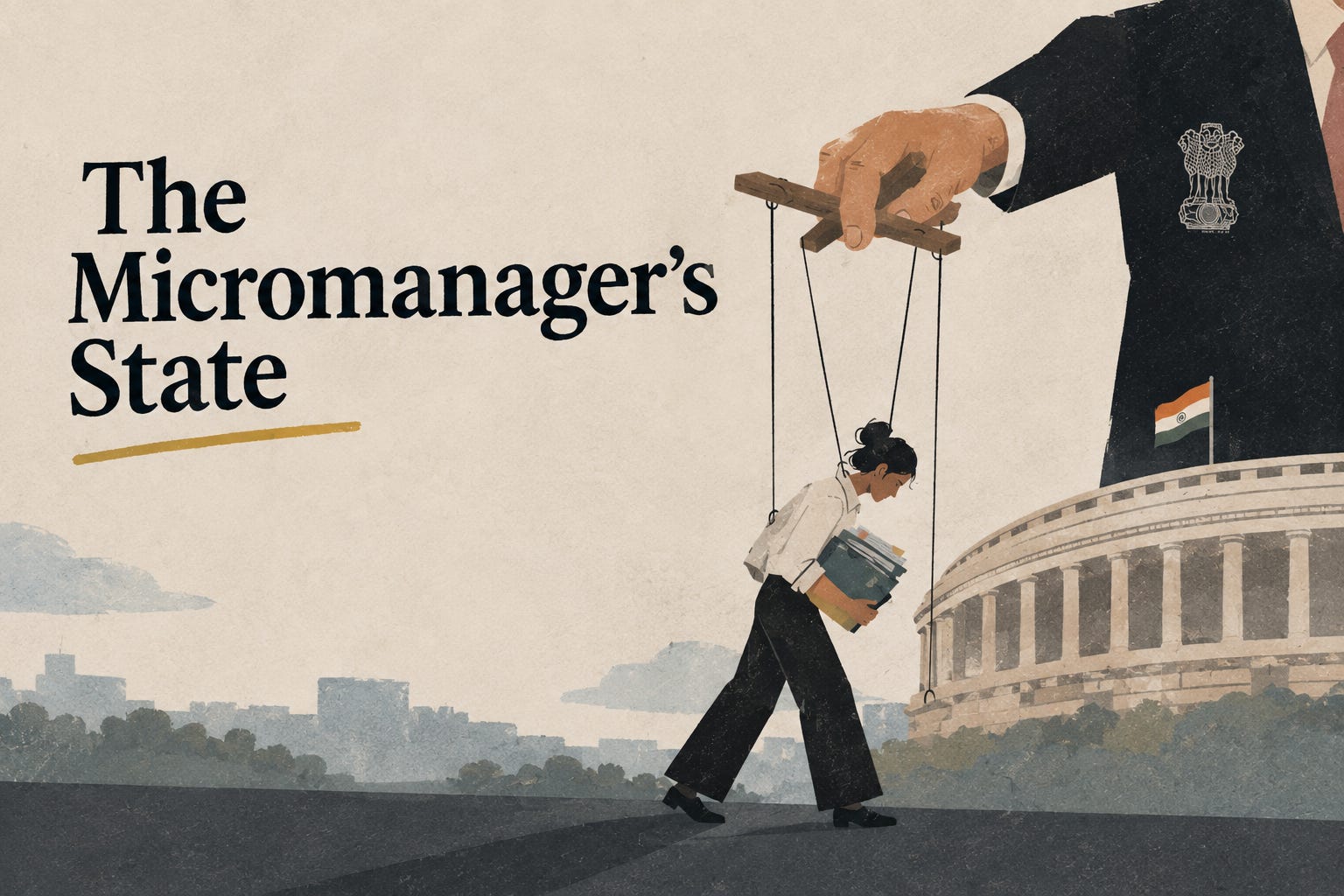
By: Siya Agrawal
The popular caricature of the micromanager is someone who insists on being copied on every email, rewrites work that others are perfectly capable of completing, and turns every decision into a request for permission. The image is familiar because nearly everyone has encountered some version of it. Yet the research literature treats these behaviours less as quirks of temperament than as symptoms of deeper institutional incentives.
Organisational psychologists have long argued that excessive control undermines initiative. Research by Richard Hackman and Greg Oldham, and later Edward Deci and Richard Ryan, consistently finds that autonomy is central to motivation, creativity, and effective decision-making.
The implications extend beyond morale. Organisations learn by allowing decisions to be made where knowledge actually exists. The people closest to a problem typically understand its particularities better than those further removed from it. Empowering them is therefore not an act of generosity. It is often the most effective way of producing better decisions. This is why contemporary organisational psychology increasingly treats excessive control as self-defeating.
Suppose we encountered an organisation that consistently displayed every behavioural characteristic associated with micromanagement. Would we conclude that generations of its leaders happened to possess unusually controlling personalities? Or would we suspect that the organisation itself had been designed for purposes that made these behaviours rational?
History offers a compelling example.
The British Indian Civil Service is frequently described as one of the most capable bureaucracies ever constructed. The Indian Civil Service was widely regarded as an unusually disciplined and cohesive administrative organisation. Its recruitment, training and hierarchical structure produced a professionalised cadre capable of exercising authority across an enormous territory. A few thousand civil servants governed hundreds of millions of people across immense linguistic, cultural, and geographical diversity.
The puzzle is how.
The Indian Civil Service is best understood by starting with its purpose rather than its reputation. It was not designed to maximise local initiative — it was designed to govern an empire, and that distinction shapes everything that follows.
Empires face a structural problem that has nothing to do with the character of the people running them. Authority has to be exercised across territories that are geographically distant, politically varied, and only partially legible from the centre. The officials on the ground almost always know more about local conditions than their superiors do, yet it’s the superiors who remain accountable for the outcomes. This creates a recurring dilemma for any imperial system: how does the colonial state ensure distant officials faithfully implement its priorities?
The British answer was not to eliminate discretion altogether. A district collector exercised enormous discretionary authority over taxation, policing, justice, famine relief, and public order. But crucially, that discretion was embedded within a structure whose primary loyalty pointed upward rather than outward. The bureaucracy therefore evolved around a principle that organisational psychologists would immediately recognise. When trust cannot be assumed, control must be designed.
Once this principle became embedded in organisational routines, it began producing a predictable pattern of behaviour: authority migrated upward, information flowed upward, responsibility flowed downward, and discretion became something to be monitored rather than cultivated.
When India became independent, it inherited not only the personnel of the old administrative state but much of its operating philosophy. Sardar Vallabhbhai Patel famously defended the continuation of the civil service as the “steel frame” that would hold together a fragile new republic. Given the upheaval of Partition, the integration of princely states, and the immense task of nation-building, the decision was understandable. Yet while the objectives of the state changed dramatically, the architecture of administration changed far less.
The colonial bureaucracy had been designed to govern subjects. The democratic state now sought to serve citizens, foster development, and implement ambitious social and economic programmes. But organisations do not automatically acquire new habits when they receive new missions. They tend to pursue new goals through familiar methods.
This is where organisational psychology becomes more than a metaphor.
A micromanaging organisation does not merely slow decisions at the top. Over time, it changes the behaviour of everyone below. When every choice requires approval, initiative becomes less valuable than anticipation. Success depends not on solving problems creatively but on accurately predicting what one’s superiors will accept.
This helps explain a paradox that frequently appears in discussions of Indian governance. Individual civil servants are often highly capable, deeply committed, and exceptionally competitive to recruit. Yet the system within which they operate is frequently criticised for procedural delay, excessive caution, and limited experimentation. Those observations are not necessarily contradictory. Highly capable individuals can still become procedurally cautious if the institution rewards procedural defensibility more reliably than discretionary success.
The colonial inheritance also helps illuminate another enduring feature of the bureaucracy: its preoccupation with visibility.
One of the defining habits of the micromanager is the belief that seeing work is equivalent to controlling it. The British governed immense territories with astonishingly few officials. They compensated by creating systems that rendered society legible through paperwork. Bernard Cohn described colonial rule as an exercise in producing knowledge, through censuses, surveys, classifications, and records, that made administration possible.
The difficulty arises when technologies developed to maintain control become ends in themselves. Organisations can gradually begin optimising what they can measure rather than what they hope to achieve. Producing documentation becomes easier to evaluate than exercising good judgement. Completing procedures becomes more professionally defensible than adapting creatively to local circumstances.
Here the argument intersects with economics. Friedrich Hayek’s famous insight about dispersed knowledge is often invoked in debates over markets, but its deeper relevance concerns organisations. Knowledge is fragmented. Much of what matters is local, contextual, and impossible to communicate fully through reports. The “man on the spot” frequently possesses information that cannot be transmitted upward in its entirety. A bureaucracy optimised for central oversight inevitably confronts this limitation
The claim I make here is not that the Indian state behaves like an overbearing office manager. Nor is it that bureaucrats are, by temperament, micromanagers. The claim is institutional. Organisations built to maximise political control, standardisation, and upward accountability tend to generate behavioural patterns that organisational psychologists recognise as the consequences of micromanagement. The colonial state adopted those patterns because they solved the problems of imperial governance. Independent India inherited many of the same institutional routines because replacing them was vastly more difficult than repurposing them.
Institutions rarely begin each generation with a blank slate. Administrative reform is therefore about more than reducing red tape or digitising government services. It requires reconsidering the assumptions built into the architecture itself. If the objective of a democratic state is not merely to maintain order but to enable citizens, then discretion cannot always be treated as a threat. Local knowledge cannot remain subordinate to distant visibility. Initiative cannot flourish where compliance is the safest career strategy.
Organisational psychologists have spent decades showing that resilient institutions do not emerge by eliminating discretion but by designing for responsible autonomy. They distribute authority because they recognise that knowledge is dispersed. They cultivate trust because constant supervision is an expensive substitute for it. They encourage experimentation because adaptation depends on learning rather than perfect foresight.
The irony is that these are precisely the qualities an empire could least afford.
The colonial bureaucracy was not dysfunctional. It was remarkably well adapted to the task for which it had been created. Its emphasis on control, surveillance, standardisation, and upward accountability reflected a coherent institutional logic.
The question confronting India today is whether an administrative system designed to govern an empire can fully realise the ambitions of a constitutional democracy.
About the author:
Siya Aggarwal is an undergraduate student at IIM Kozhikode interested in public finance, political economy, and financial regulation. She is particularly interested in how economic policies and institutions shape incentives for firms and individuals in developing economies.