

By: Abhinav Bhatia
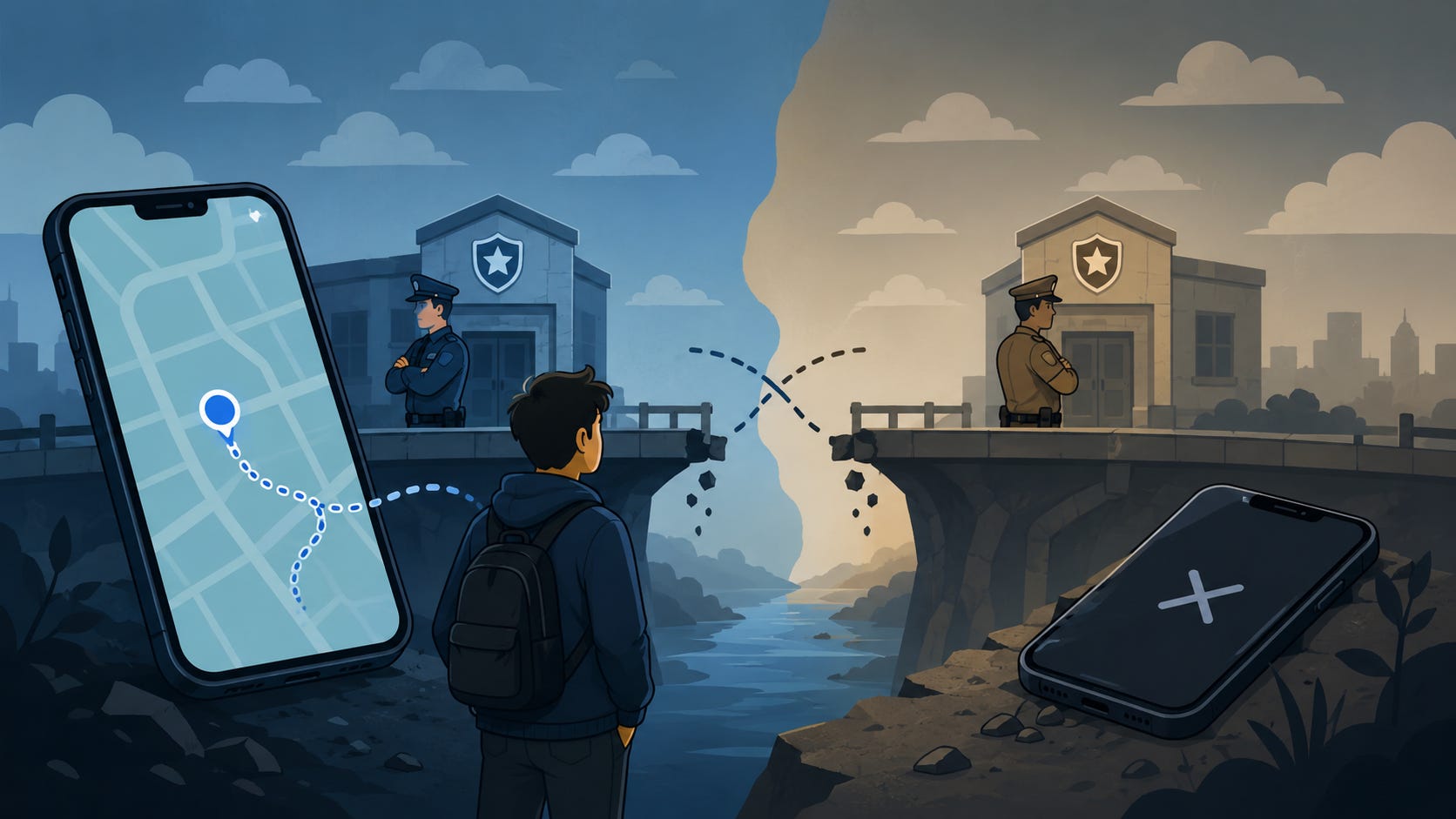
So my phone got stolen. It’s a bummer, right? But, fortunately, I knew exactly where it was. Apple’s family sharing feature in Maps meant I could track my phone in real time, a blue dot moving through streets I could name, updating every few minutes, broadcasting its location with quiet precision. What I did not have was anyone willing to act on that information. What followed was not simply a frustrating experience with bureaucracy. It was a reminder of a lesson in political philosophy from my undergrad days.
Social contract theory, developed by Hobbes, Locke, and Rousseau, holds that individuals voluntarily surrender certain freedoms to the state in exchange for protection, security, and justice. Hobbes in Leviathan (1651) described this as laying down one’s “right to all things” so that the state may act “for their peace and common defence” (Hobbes, 1651, Ch. XIV & XVII). John Locke, whose version of the social contract was more reciprocal than Hobbes’s, highlighted that the state’s authority is not unconditional. In the Second Treatise of Government (1689), Locke argued that “the reason why men enter into society is the preservation of their property”, which encompasses life, liberty, and estate, and that government exists solely as a “guard and fence” for those rights (Locke, 1689, sec. 222.). When the state fails this obligation, it does not merely disappoint; in Locke’s own terms, it commits a “breach of trust” by which it forfeits the very power the people had placed in its hands (Locke, 1689, sec. 222.).
Thus, the logic of the contract is straightforward: you give up the right to retrieve (here by force) what is yours, and in return, the state assumes the obligation of doing it for you, lawfully, proportionately, and reliably. This restraint is not incapability or weakness. To be honest, the thought of hiring someone to retrieve the phone or of showing up at the thief’s location myself did cross my mind. What stopped me was not incapacity, but the contract, the unwritten agreement that binds every law-abiding citizen to formal channels even when those channels are failing them.
So, I did what I could do: I filed the FIR. I returned to the station. I shared the live location. I waited. What I did not know at the time was that the theft had occurred on the border between two states, a geographic accident that became a huge problem. Each state’s police force pointed at the other. Responsibility was passed back and forth until the device, which had been moving and traceable, came to a permanent stop, and the phone was gone. A phone that technology had made easy to recover had been lost entirely to an institutional drama.
Moving away from political philosophy, let’s view this from an economic lens. I am a taxpaying citizen. The state institutions are funded by taxes that people like me pay. This is a very important detail that people seem to forget. In a democracy, public institutions are not doing citizens a favour when they respond to a crime; they are fulfilling a function that citizens have already paid for. Even if we remove the tax lens, when these institutions fail, it is not just a service failure. It is a breach of the same social contract that runs in both directions.
This is one example of what’s called the principal-agent problem. The principal-agent problem is a conflict of interest that occurs when one person or entity (the “agent”) makes decisions or takes actions on behalf of another person or entity (the “principal”). In the public sector, the problem arises when there is a disconnect between the goals and interests of politicians or public servants and the citizens they are supposed to serve. In theory, the police are agents acting on behalf of the citizen, the principal. In practice, when jurisdictional ambiguity makes accountability impossible to assign, agents on both sides of a state border can evade their responsibilities entirely, leaving the principal with no recourse. The information was there. The location was live. What was missing was any agent willing to be accountable for acting on it.
The arguments discussed above reveal the deeper problem. The issue is not that the authorities were unkind or that the system is entirely broken. It is that the structure of institutional accountability has not kept pace with the technology available to ordinary citizens. A normal mobile can now broadcast its precise GPS coordinates continuously. The limiting factor in recovering a stolen mobile is no longer a lack of information; rather, it is institutional and jurisdictional clarity. When those fail, the person who loses most is the one who followed every rule, trusted every channel, and exercised exactly the restraint the social contract asks of them; they are the ones who bear the cost (both literally and figuratively) of the state’s failure.
A democratic society asks its citizens to be law-abiding not merely as a civic duty but as part of a reciprocal arrangement. The state’s end of that arrangement is not optional. In my case, when jurisdictional ambiguity became a reason for inaction rather than a problem to be resolved, and when a law-abiding citizen’s only reward for restraint is an irretrievable loss, the contract is not being upheld; it is literally being broken. The blue dot went still on a Tuesday afternoon, and I received an update from the police station that the phone is no longer traceable. The question it left behind is harder to switch off: what do citizens make of institutions that are absent when they are needed most?
Citations:
Hobbes, T. (1651). Leviathan. Project Gutenberg. https://www.gutenberg.org/cache/epub/3207/pg3207-images.html
Locke, J. (1689). Second treatise of government. Hanover Historical Texts Collection. https://history.hanover.edu/courses/excerpts/165locke.html
About the Author:
Abhinav holds a BA in Political Science and an MA in Development Studies, and brings experience in research, policy communication, and stakeholder engagement. His interests span sustainability, social entrepreneurship, and social sciences. He currently works at CCS as an Associate in the Academy.