

By: Nisshat Sheikh
The moment I step outside my PG to go to the library or Centre for Civil Society (CCS) office, my movement is often interrupted by cattle occupying the narrow lanes of Vijay Nagar near Delhi University’s North Campus. Sometimes there are one or two; at other times, an entire herd. These scenes are not unique to one neighbourhood -they are a familiar sight across much of Delhi.
Freely roaming cattle are more than an inconvenience. They contribute to traffic congestion, cause road accidents, and in some cases, even fatalities. A Hindustan Times report from 2024 noted that three people died in cattle-related road accidents within a single month. Separately, a New Indian Express report, drawing on Delhi Police data, highlighted stray animals on roads as a contributing factor to road crashes, alongside poor lighting and other road safety concerns.
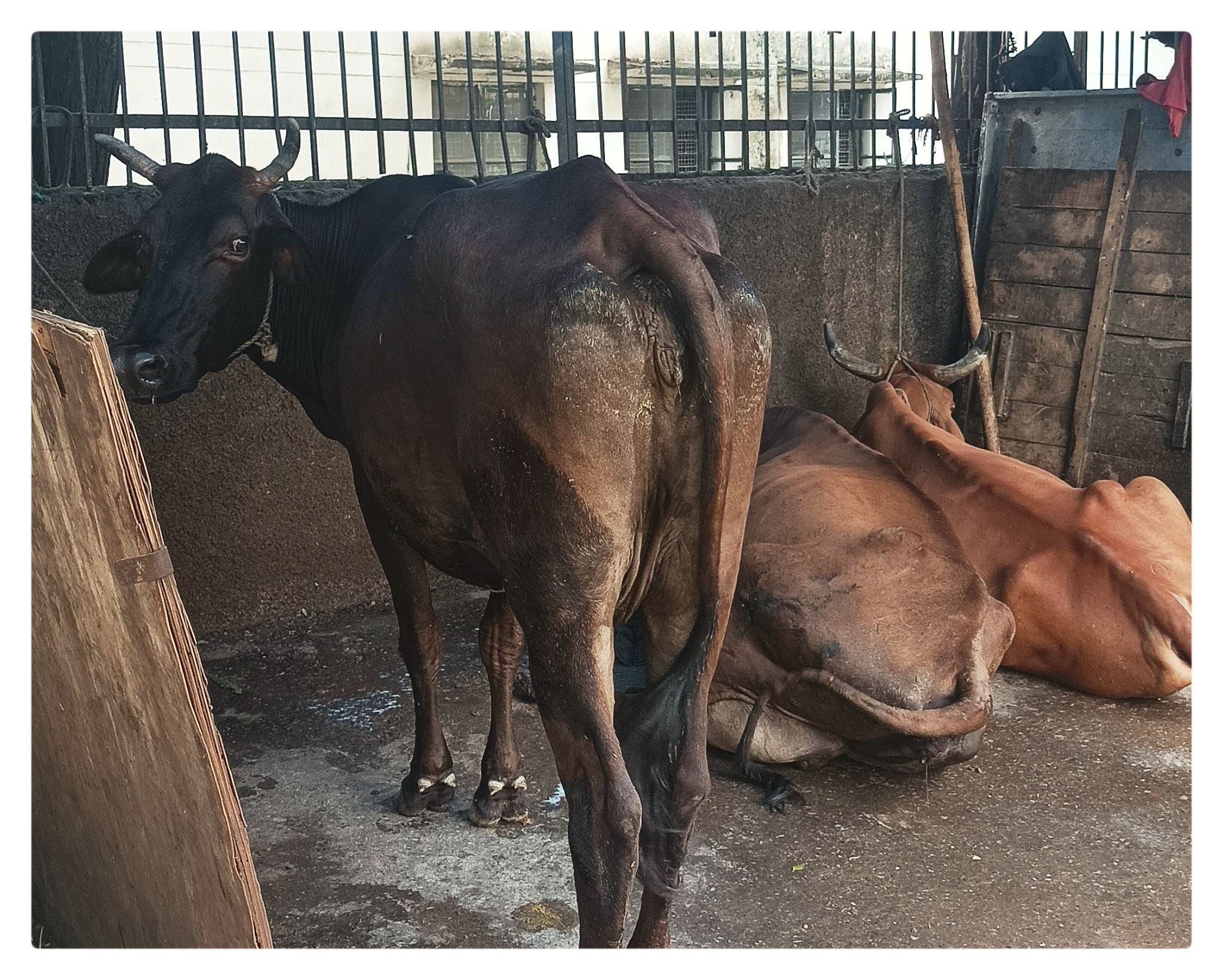
At first glance, this appears to be a problem of weak municipal enforcement. My fieldwork, however, suggests something more fundamental. Many of the animals occupying the city’s roads are not abandoned but privately owned. The real challenge is not merely the presence of cattle in public spaces, but the absence of effective systems to trace ownership and enforce accountability, allowing the costs of private ownership to be borne by the public.
While speaking to a worker at one of the gaushalas in Gurmandi, North West Delhi, I discovered that not all cattle on the roads are abandoned. Many of them have owners. When asked why they let their cattle roam freely, some owners responded, “These cattle are like our family members. Does anyone cage their family?” Others argued that “Delhi once had more open spaces where cattle could roam. Urbanisation and population growth have taken away those spaces, but that does not mean we should keep them tied up forever.”
The owners of these cattle acknowledged that cattle create problems on the roads. However, they also pointed to their own constraints. With limited space to house their animals, many believe they have no option but to let them roam. Most owners agreed in principle that relocation would be acceptable. However, they argued that the absence of affordable alternatives within or around the city leaves them with little practical choice but to continue operating where they currently are.
Pedestrians, however, tell a different story. One resident complained that vehicles often cannot leave their lane because herds block the entrance. Apart from littering the roads and creating an unpleasant odour, cattle pose a genuine safety risk, especially for two-wheelers that skid on slippery roads. A university student even told me that she had to shift her PG because e-rickshaw drivers refused to enter lanes regularly clogged with cattle. These conversations reveal that the issue is not simply one of abandoned cattle, but of privately owned animals whose ownership is rarely visible to authorities.
This raises an important question: who should bear responsibility for cattle occupying public roads? Is the problem rooted in inadequate municipal capacity, insufficient animal shelters, the informal nature of the dairy sector, or a broader failure of urban governance or the cattle owners themselves?
Recent government interventions illustrate how policy has focused primarily on managing cattle after they occupy public roads rather than addressing why they continue to do so. Public attention intensified only after stray cattle reportedly delayed the Chief Minister’s convoy. The incident prompted the Delhi Government to allocate ₹40 crore to develop modern cow shelters in Ghumanhera to improve the sheltering and management of stray cattle. Yet existing gaushalas are already overcrowded, making it difficult for the Municipal Corporation of Delhi (MCD) to relocate cattle from public roads. While these measures address the immediate presence of cattle, they do little to improve traceability of ownership.
The problem is compounded by the largely informal nature of the dairy industry. Many cattle are bought and sold without proper documentation, making it easy for owners to abandon economically unproductive animals. Although several owners claimed they possessed documentation, none were able to produce it during my conversations. As such, establishing ownership often remains difficult. This raises a larger question: why do privately owned cattle continue to occupy public spaces in the national capital, often without any identifiable ownership?
Madhya Pradesh faced a similar challenge and attempted to address it by introducing colour-coded identification tags to distinguish privately owned cattle from stray animals. Such measures make tracing ownership considerably easier.
The legal framework in Delhi also reflects a gap. Article 48 of the Constitution, under the Directive Principles of State Policy, directs the State to preserve and improve cattle breeds and prohibit the slaughter of cows, calves, and other milch and draught cattle. In line with this, the Delhi Government enacted the Delhi Agricultural Cattle Preservation Act, 1994, which prohibits the slaughter of agricultural cattle. However, the Act remains silent on what happens when cattle become economically unproductive. The law protects cattle but provides little guidance on assigning responsibility once privately owned animals enter public spaces.
This transforms the issue of stray cattle into a broader problem.
The economics of Delhi’s stray cattle crisis can be understood through Garrett Hardin’s insights on the Tragedy of the Commons. Although public roads are not commons in the traditional sense, they function as an open-access resource for the movement and grazing of privately owned cattle. Individual owners reduce their maintenance costs by allowing cattle to use this shared space rather than bearing the full costs of housing and feeding them. For each owner, this decision appears rational. Collectively, however, when many owners make the same choice, the result is congestion, road accidents, deteriorating sanitation and shrinking public space. The case therefore resembles Hardin’s broader insight that individually rational decisions can generate socially undesirable outcomes when access to shared resources remains weakly governed.
This dynamic also represents a classic case of a negative externality. Owners earn private benefits through the sale of milk and dairy products, while commuters bear the costs of delays, pedestrians face safety risks, and municipalities struggle with enforcement. Because many cattle cannot be traced back to their owners, authorities are often unable to fix responsibility or take timely action.
Beyond ownership, the crisis also exposes shortcomings in urban planning and governance. City planning cannot focus exclusively on residential and commercial expansion while ignoring the realities of existing economic activities. Rapid urbanisation has steadily reduced grazing spaces without creating viable alternatives for livestock owners. This reveals a disconnect between urban planning and livestock governance—one that is particularly significant in a city like Delhi.
Improving traceability, rather than merely expanding shelter capacity, should therefore become the focus of policy. Although the Delhi Government has proposed spending ₹40 crore on new shelters, the objective should not simply be to remove cattle from the roads. The larger goal should be to ensure that those who benefit from cattle ownership are also held accountable for their upkeep. Madhya Pradesh’s proposal to assign unique 12-digit identification tags, along with colour-coded markers distinguishing stray and domesticated cattle, offers one possible way to improve traceability and accountability.
Delhi’s stray cattle problem is often framed as a question of animal welfare or municipal inefficiency. My fieldwork suggests that it is, more fundamentally, an institutional problem of ownership and accountability. When privately owned cattle occupy public roads without effective systems to assign responsibility, the costs of ownership are borne by society. Better shelters may alleviate congestion temporarily, but they cannot resolve the underlying incentive problem.
Ultimately, the issue comes down to traceability and accountability. In rural areas, informal social norms and close-knit communities make it relatively easy to identify cattle owners, creating social pressure to manage the commons responsibly. Delhi, by contrast, is a large and anonymous city where such informal mechanisms rarely exist. In this context, effective identification systems and enforceable ownership records become essential. Without them, responsibility remains invisible, enforcement remains weak, and public spaces continue to absorb the costs of private decisions.
About the author:
Nisshat is a postgraduate in Sociology with a strong interest in education policy, gender, and social inequality. Her research spans qualitative fieldwork with tribal women in Assam and Pakistani refugee communities in Delhi, as well as quantitative analysis on the link between female education and labour force participation in India.
Strong topic for an accountability-focused article—especially if you support it with official Delhi municipal/government records and clear evidence on responsibility, ownership, and enforcement.