

I was scrolling through Instagram when a reel stopped me mid-swipe. It was about New York in the early 1990s, when it was one of the most dangerous cities in the US. In 1993, Rudy Giuliani was elected mayor and hired William Bratton as police commissioner. Everyone expected a dramatic crackdown on crime, but that’s not what happened. They cleaned the subways, fixed broken windows, and cracked down on fare evasion and graffiti. Could you guess what happened to the crime rate? They plummeted: violent crimes reduced by 56% over eight years and murders declined by nearly two-thirds. Out of curiosity, I watched it twice.
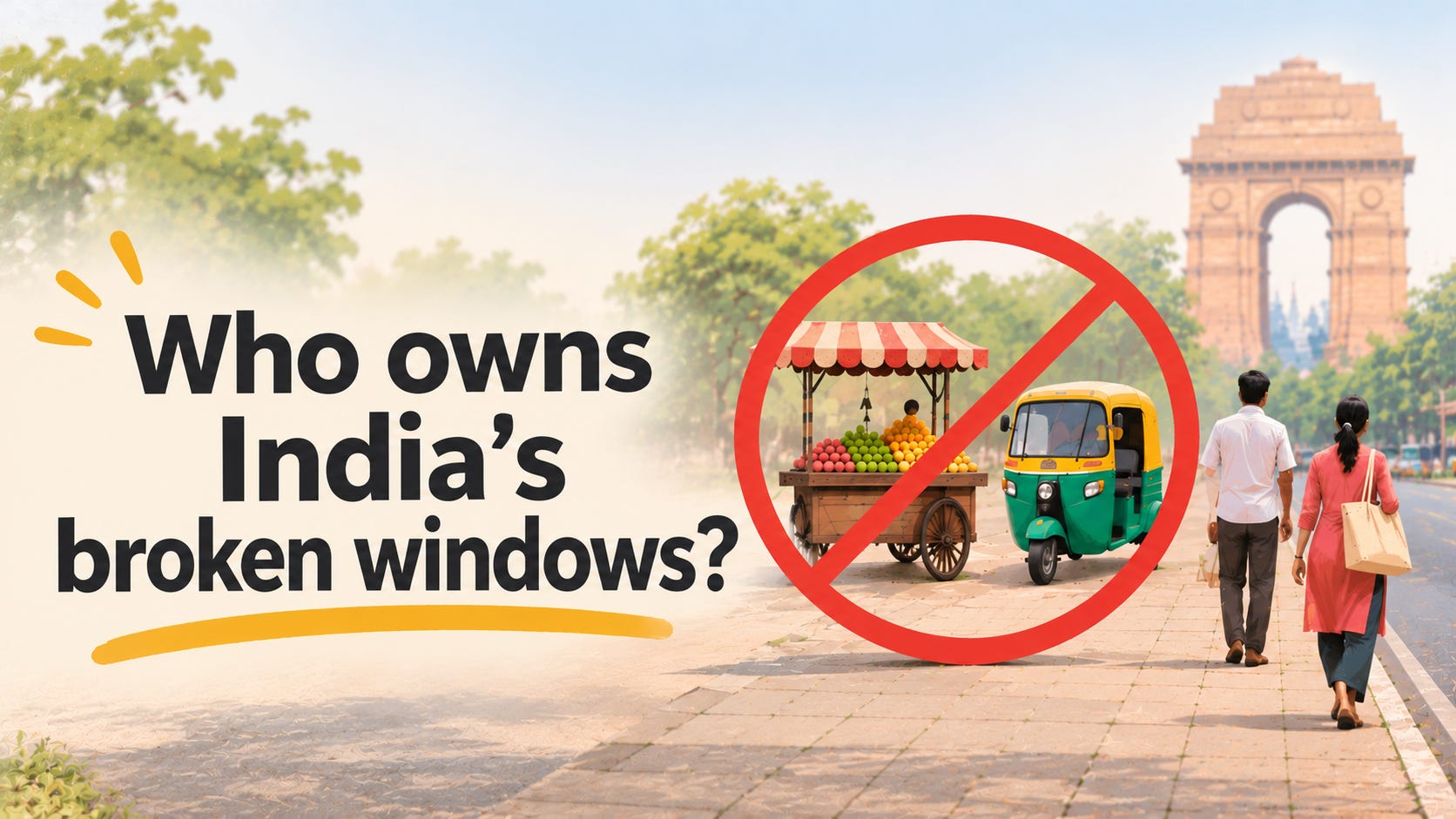
James Q. Wilson and George Kelling proposed the broken windows theory in 1982 in an article in The Atlantic, arguing that visible signs of disorder—a broken window, graffiti on a wall, litter on a street—send a signal to the people. The signal is simple: no one is in charge here, standards are low, and one could do what they want. If the signal goes unchallenged, it invites further disorder and, eventually, violent crime. While such trivial law enforcement has not convinced everyone, the broken window perspective was simply a metaphor, an idea, intended to inspire city officials, police leaders, and community members to control crime by addressing underlying disorderly conditions, instead of penalising. In other words, fixing the environment works; penalising people for living in a broken environment does not. Which brings me to the question the reel left me with: what does broken window theory look like for our cities?
Now, when applied to India, the broken window idea is not an argument for cracking down on the street vendor who parks his cart on the footpath or the auto driver who jumps a signal. These are people navigating a broken environment that was never designed with them in mind. Penalising them for surviving in a system that fails them is not maintaining public order; it is another way to make the poor pay for problems they did not create. The same was true of people penalised for fare evasion in the New York subway: they were not the people who designed a subway system so underfunded that fare evasion was a rational response to poverty.
India’s cities are not broken in one or two places. They are broken comprehensively and systematically, not because Indians are less civic-minded, but because (as I have written about before in my previous blog), nobody owns the whole picture. PWD owns the road. The municipal corporation owns the lights. Traffic police own the signals. When five departments share one street, and none of them is accountable for how it looks, the result is a permanent signal of disorder not because anyone chose chaos, but because the structure makes order impossible to maintain. One broken window, left unrepaired, because no one is sure whose job it is to fix it.
The question for India is not whether to fix broken windows. It is who is responsible for fixing them and whether we have built institutions capable of doing that job. Aggressive enforcement of trivial laws without first fixing the environment that produces disorder is not broken windows theory. It is just broken governance with a new name. Fix ownership, fix accountability, and maintain the environment and behaviour; over time, the signal will change to: someone cares about this place; when people believe someone cares, they tend to act accordingly.
About the author:
Abhinav holds a BA in Political Science and an MA in Development Studies, and brings experience in research, policy communication, and stakeholder engagement. His interests span sustainability, social entrepreneurship, and social sciences. He currently works at CCS as an Associate in the Academy.