

By: Dinesh Rai
Every year across India, about 22–23 lakh medical students sit for the NEET-UG, and only around one lakh secure seats in government medical colleges. This year, the exam took place on 3 May. Within a few days, investigators found that the paper had been compromised (Tognolini, 2026). A digital “guess paper” had circulated on Telegram and WhatsApp before the test and matched many real questions. The government cancelled the test nationwide. Protests broke out at Jantar Mantar in New Delhi. Officials passed a new law with stricter penalties and ordered faster probes. The prime minister promised tougher action.
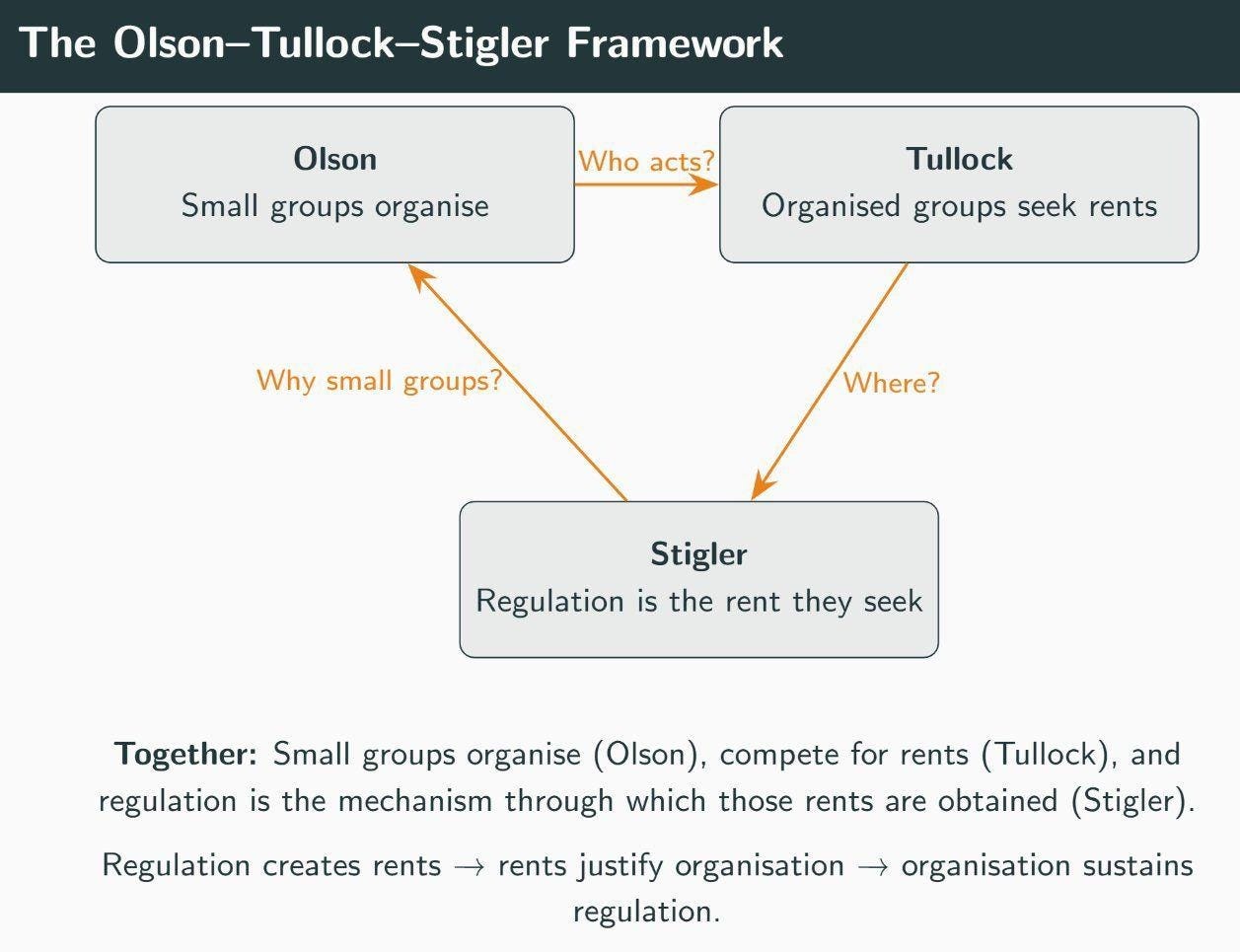
Laws against paper leaks are necessary, yet they leave the deeper problem untouched. India’s medical education system is a clear contemporary case of the Olson–Tullock–Stigler framework. The intense competition for medical seats is driven less by the country’s actual need for doctors and more by the large rents this sector offers. We see these rents in hidden admission fees and the huge costs of medical training. These rents are extra money that people extract without creating matching value for others (Henderson, 2018). They create strong incentives to enter and stay in the system. Organised groups–existing practitioners, medical associations or college owners–have a vested interest in keeping the system in their favour through regulatory barriers. These restrictions create large rents for a few, while the costs spread across the whole population.
Why Simply Adding More Seats Won’t Work
Many people say the government should simply add more medical seats because India needs more doctors. This sounds like a good idea. However, the real issue is not a lack of seats. The issue is: why do so many students take the exam in the first place? The massive rent attracts students. If we change the system to focus on actual healthcare needs, this rent will shrink. Students’ motives will then change. We saw this in the Indian Revenue Service. When the government introduced faceless tax assessments, the chance to take bribes fell. Many officers resigned (Kumar, 2025). People are not simply good or bad. The system shapes how they act. Just adding more medical seats will only attract more people chasing the same rent (Sanjay Maurya & Shukla, 2026).
A Need-Based Healthcare System
Strong financial and insurance markets help a country prosper (Panda et al., 2020). India’s stock market is now worth several hundred lakh crore. Why do people trust the market with so much money? The Securities and Exchange Board of India (SEBI) is the answer. SEBI has built solid rules for the market. These rules protect everyday investors. Health insurance, however, still covers far fewer people. A NITI Aayog report on ‘Health Insurance for India’s Missing Middle’ shows the scale of the gap: roughly 40 crore people still have no health insurance at all. The Insurance Regulatory and Development Authority of India (IRDAI) is now working hard to build trust between companies and insurers (Mathew, 2026).
A competitive health-insurance market is one of the best ways to reduce rent-seeking. Look at motor insurance today. It is highly competitive. Companies make money by covering millions of people and still settle claims fairly. The same logic can work in health. Managed-care arrangements that link insurers, hospitals, laboratories and pharmacies can spread risk and control costs. Teams of doctors, nurses and physician assistants can handle most routine primary care (Hu et al., 2024). This frees doctors to specialise where the country truly needs them. At present, many doctors gather where the rent is highest, not where patients need them most. Cardiology attracts more doctors than neurology even though neurologists are scarce in many districts (Gupta, 2026). An insurance market creates clear signals. Those signals pull doctors toward the places and specialities that patients actually need.
Where we are standing right now matters a lot.
We cannot ignore the current friction between doctors, patients, and insurers. Delayed approvals, rejected claims, and heavy paperwork are real challenges. Yet when more people join an insurance pool, the system grows stronger and more stable (Smith & Kane, 1994). Motor insurance already shows this is possible (Staff Reporter, 2025). Public acceptance will grow as the benefits spread, just as they did with the stock market.
True reform must protect the public from rent. It must also stay watchful of people who claim to speak for patients or the profession while defending arrangements that mainly serve themselves.
About the Author:
Dinesh Rai is a PhD Student of economics at the Indian Institute of Technology Patna. He works on agricultural price policy, specifically its distributional impact on various sections of farmers in India, as well as the barriers and policy solutions for linking farmers to markets.
Bibliography
Gupta, D. P. (2026, July). Why India needs a neurologist in every district. Express Healthcare. https://www.expresshealthcare.in/news/why-india-needs-a-neurologist-in-every-district/454164/
Henderson, R. David. (2018, February 5). Rent Seeking. Econlib. https://www.econlib.org/library/Enc/RentSeeking.html
Hu, X., Coplan, B., Barnes, H., Smith, N., Essary, A., & Dill, M. (2024). Physicians working with physician assistants and nurse practitioners: perceived effects on clinical practice. Health Affairs Scholar, 2(6), qxae070. https://pmc.ncbi.nlm.nih.gov/articles/PMC11196955/
Kumar, A., & Sarwal, R. (2021). Health insurance for India’s missing middle. NITI Aayog.
Kumar, P. Sesh. (2025, December 22). 853 IRS Officers Quit in a Decade: Tax Service Losing Its Soul?. The Raisina Hills. https://theraisinahills.com/853-irs-officers-quit-in-a-decade-tax-service-losing-its-soul/
Mathew, G. (2026, July 30). How IRDAI’s latest reforms could reshape India’s insurance sector. The Indian Express. https://indianexpress.com/article/explained/explained-economics/irdai-insurance-reforms-explained-10810249/
Scheffler, R. M. (2008). Is there a doctor in the house?: market signals and tomorrow’s supply of doctors. Stanford University Press.
Smith, M. L., & Kane, S. A. (1994). The Law of Large Numbers and the Strength of Insurance. Huebner International Series on Risk, Insurance and Economic Security, 1–27. https://doi.org/10.1007/978-94-011-1378-6_1
Staff Reporter. (2025, May 20). India’s motor insurance market to hit $21.5b by 2030. Insurance Asia; Charlton Media Group. https://insuranceasia.com/insurance/news/indias-motor-insurance-market-hit-215b-2030
Tognolini, P. N. J. (2026, August 7). NEET doesn’t need more security. It needs a better design. The Hindu. https://www.thehindu.com/education/neet-doesnt-need-more-security-it-needs-a-better-design/article71312788.ece
Tullock, G. (2003). The Origin of the Rent-Seeking Concept. International Journal of Business and Economics, 2(1), 1–8. https://www.ijbe.org/table-of-content/pdf/vol2-1/01.pdf